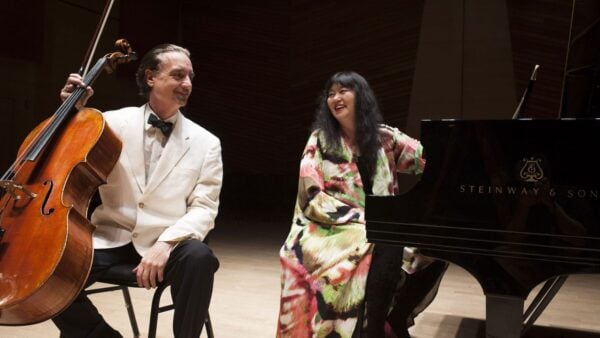
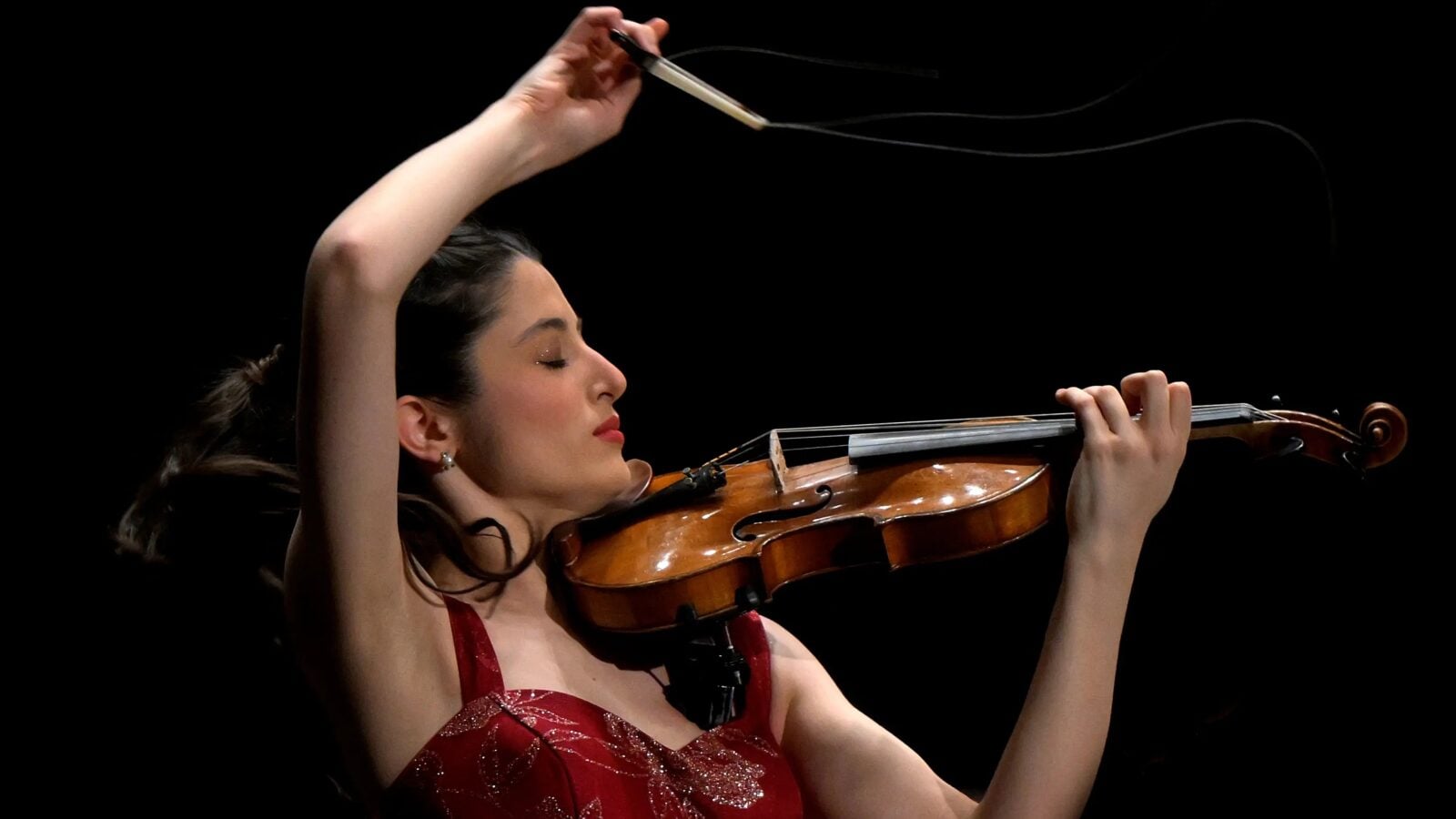
Maria Duenas. (Photo: Allan Cabral)
Precision. Elegance. Control. Discipline. These qualities are difficult to separate from the legacy of Jascha Heifetz, one of the most prominent violinists of the 20th century. Even at the most impassioned moments of a performance, Heifetz was known for his restrained manner and largely expressionless demeanor, dressed in concert black. His playing, by contrast, helped make him a central figure in what has come to be known as the “Golden Age of Violin.”
Heifetz died in 1987, but his recordings remain a reference point for violinists. Among them is Maria Dueñas, the 2025 Gramophone Young Artist of the Year, who has joined Gustavo Dudamel and the Simón Bolívar Symphony Orchestra of Venezuela for an album devoted to music associated with Heifetz’s recorded repertoire.
To celebrate the album’s release, WFMT spoke with Dueñas about Heifetz, musical lineage and the complicated business of choosing one’s musical role models.
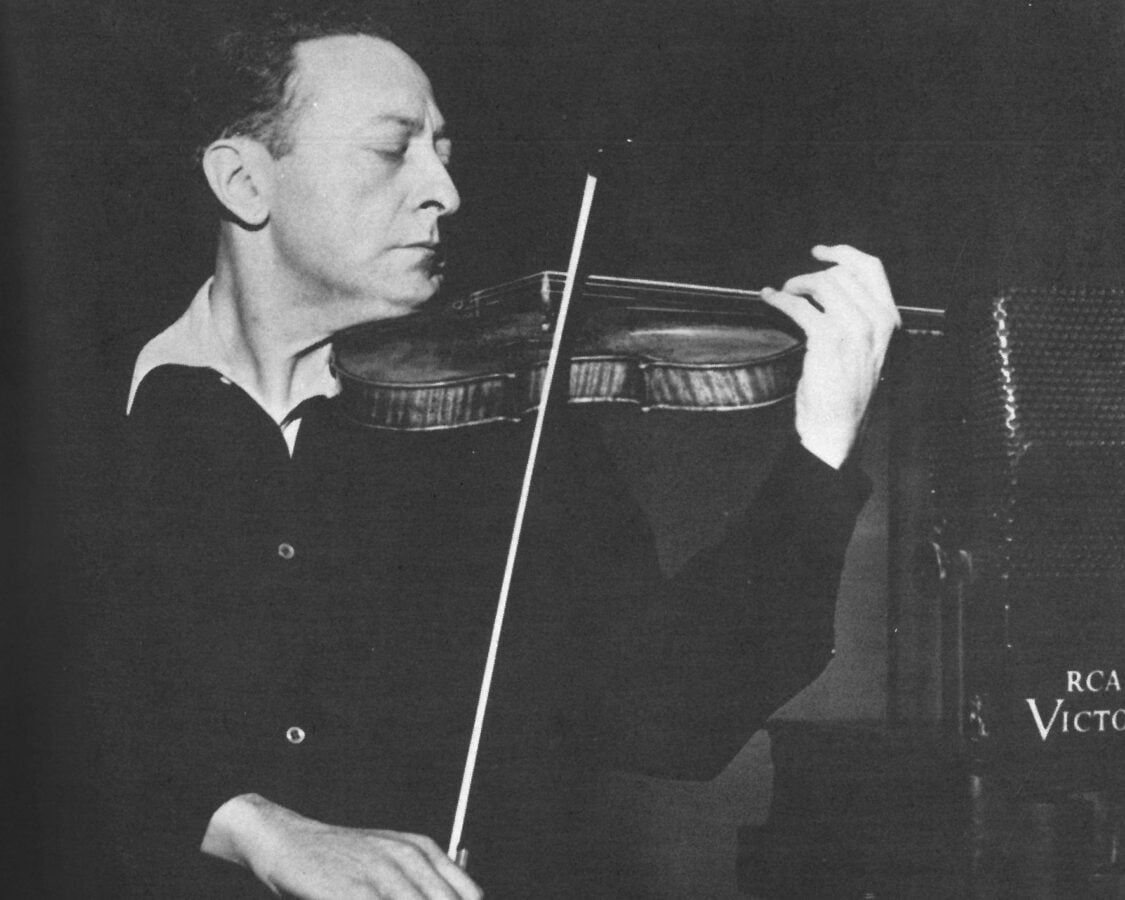
Jascha Heifetz, recording for RCA Victor, ca. 1950s. (Photo: Archiv, Public domain, via Wikimedia Commons)
WFMT: What comes to mind when you think about Jascha Heifetz?
María Dueñas: Jascha Heifetz was a big part of my beginnings in music. I was listening to his recordings when I was a kid, even before starting the violin. But it wasn’t until I was a bit older that I actually started recognizing who is playing.
Heifetz seems rather cold at first glance, but his sound is very warm. That really fascinated me; his playing felt very honest, very human. But my main goal was never to imitate Heifetz: I think that’s impossible; no one could ever play the same or close. But I did want to honor his legacy.
This new album is about what he means to me as a person, as an idol. When I was growing up in Spain, classical music was not as important as in other European cities. So I think it’s important to show young people that even if Heifetz is not fashionable or Instagrammable, he’s still a big idol. And maybe that can be an inspiration in some way.
WFMT: With all that Heifetz has recorded, how did you select the pieces for this tribute?
Dueñas: Well, he was such an amazing recording artist, that he recorded basically everything existing for violin! I knew that I wanted the two big concertos in this album, because it is the exact same pairing that Heifetz did. I actually discovered the Korngold violin concerto much later in life but I kind of grew up with Lalo Symphony Espanol, since I played it for the first time when I was 11.
Because the project was also so personal for me, I really wanted to have Dudamel’s input as well. We worked together for the first time during the pandemic. Since then, he had commissioned a new work for me, and we also did some smaller projects. I feel that we very much understand music in a similar way by now, so having him on the album made the recording process special. The Simon Bolivar Orchestra as well: all these young people were playing with so much joy and love for music, and that’s not always the case in a recording session.
WFMT: Which piece was the most intimidating for you to record, given its history or importance to you as a violinist?
Dueñas: I wouldn’t say I was intimidated. There was for sure lots of respect towards the music, and admiration towards this big artist that is Hafetz. In my head, though, I always had the idea that it’s about honoring the music like he did.
I think a lot of Heifetz’s recordings were created in the moment. As a fan, it seemed like the music was going effortlessly through him to the audience. So when I chose the little pieces that appear on the album, I really did want to have a little bit of each of his soundscapes. All of them are inspired by poems. We have one piece by Debussy called “La chevelure” from Chansons de Bilitis which is kind of unknown today. Estrellita is, of course, one of Heifetz’s key pieces.
There were many matching sounds and energies that made it very easy for me to just record without worry. I was able to surround myself with people that were so fitting musically: not only Duramel but also Itamar Golan, the pianist with whom I recorded these pieces.
WFMT: I understand you even borrowed Heifetz’s 1731 Stradivarius (the “Heifetz, Piel”) for some recordings on this album, yet you didn’t want to practice on the instrument too much for fear it would be infused with too much of your own sound. What did you mean by that statement?
Dueñas: I think it was more of a fantasy in my mind, because of course, so many people have played this violin after Heifetz. I wanted to somehow take this violin, which has so much history, and play the music that it might have played in the past. It was more like a spiritual experience in this sense.
Each player defines what an instrument sounds like, but the opposite is also true: each instrument has a very unique voice. If you play an instrument for some time, the instrument adapts to how you are playing and you adapt to it as well. By not practicing too much on Heifetz’s violin, I wanted to maintain a sort of untouched voice that he might have pulled from the instrument.
WFMT: You’ve mentioned this idea of being in the moment a few times so far. Is there an element of overthinking that you think is more prevalent in this generation’s musical approach, compared to the past?
Dueñas: I wouldn’t say overthinking…I think something really good about today’s generation is actually the preparation. The discipline is very high and they prepare months ahead. I think that that should be maintained.
But the preparation should be mostly technical. You have to have a very good basis, but for me, a lot of specific colors are also found on stage. There are so many circumstances that you can’t mimic in a practice room. There’s the audience; there is an orchestra that you don’t know, a conductor, so many people intertwined in the same place. That affects the sound of a performance as well.
WFMT: Your star is shining very brightly these days – you were Gramophone’s Young Artist of the Year, Winner of the Opus Klassik Award, constantly touring…how do you stay balanced, under all the pressure?
Dueñas: Well I’m still young, so I don’t know how it will develop over the years, but I don’t really like the feeling of routine: even if I’ve played something 100 times, I will still prepare and be at 100% for each concert. I think the audience deserves it.
Right now, I’m approaching my life with curiosity. I’m very much trying to define what I want in life in the next years to come. By approaching the music with curiosity, too, I think that that hopefully keeps it alive for both myself and my audience.
Also, whenever I come back home, I try to really have a nice balance of something that’s not music for a change: like sports, nature, or reading.
WFMT: Finally, if you had the chance to sit down with Jascha Heifetz and ask him one question, what would it be?
Dueñas: I would actually talk to him about his immigration to the U.S. because I feel that that’s similar to my start in music. I moved out of Spain when I was very young to a foreign country with a foreign language. He was also, I think, 16 or even younger when he moved.
I’m interested in the humanitarian aspects of people, of artists. It would be fun to ask him personal, human questions, about the books he read or the music he listened to – something like that. Of course, there are many musical things that I could ask, but at the end of the day, who you are as a person very much influences the music you make.
This interview has been edited for length and clarity.