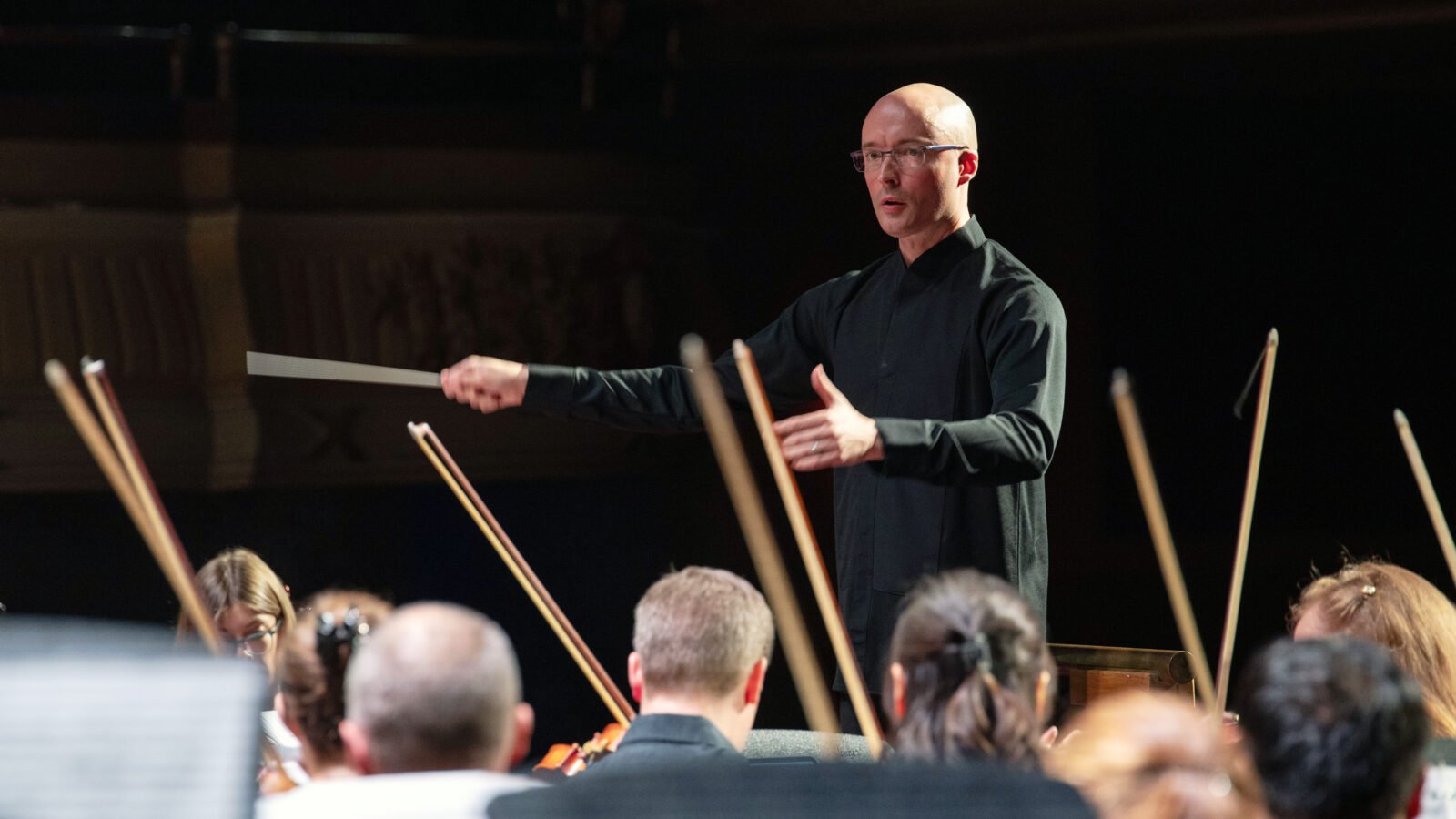
Gregory Hughes conducts the Lakeview Orchestra (Photo: Ryan Bennett)
A booming, triumphant coda. As Shostakovich’s Leningrad Symphony concludes, so does an era for the Lakeview Orchestra.
In June, Gregory Hughes, the amateur orchestra’s founding artistic director, completed his tenure in exuberant fashion.
The epic Russian masterwork demands an enormous ensemble — so much so, that it is almost prohibitively expensive for most symphony orchestras to put on.
But, as Hughes points out, the Lakeview Orchestra is a volunteer orchestra. And far from a hurdle, that can be a strength.
“When it’s an all-volunteer orchestra and everybody’s doing it for the fun of it,” Hughes explains, “it’s sort of like, ‘Why not!? Let’s do this crazy piece and scratch it off our bucket list.’”
This ambition highlights the orchestra’s dedicated approach, and has led to such highlights at the Chicago premiere of George S. Clinton’s The Rose of Sonora and a collaboration with the Violins of Hope project, all while establishing a long term artistic home at Lakeview’s Athenaeum Center.
Hughes grew up in the Cincinnati area, where he remembers being inspired by conductor Paavo Järvi during the conductor’s tenure at the Cincinnati Symphony Orchestra. “I’ve always had a soft spot for conducting because of that.”
He took up the bassoon and matriculated to Chicago area’s Wheaton College to study the instrument. And while there, Hughes resourcefully cobbled together conducting opportunities in the form of training and gigs. Now, he’s made another transition, moving on from the orchestra he helped build and into an administration role as the executive director of the Elmhurst Symphony Orchestra.
At this inflection point for the amateur ensemble, WFMT spoke with Gregory Hughes about the 13-year history of the ensemble, his philosophy on community and artmaking, and the future for the Lakeview Orchestra.
WFMT: Walk us through the history of the orchestra.
Gregory Hughes: Lakeview was formed in January of 2013. And then we had our first performance in February of 2013. The core group of musicians had existed and sort of played together as an orchestra under the umbrella of the Lakeside Pride music ensembles prior to that.
The musicians were aligned with this idea that it was going to be a little bit more of a reading orchestra, an orchestra for the players, not necessarily for the audience. We wanted to do this to make this music for ourselves.
We’ve always pushed into repertoire that’s difficult, not necessarily out of the ordinary, but that is big and epic. We want to tackle the same pieces that the professionals play.
WFMT: How does this ambition play into your decision to step away from the orchestra?
Hughes: I feel that it’s good for organizations like this to exist on their own, apart from any one leader or conductor or founder. It’s healthy for an organization to go through leadership transitions.
I have no doubt that this orchestra will continue to thrive because of the examples of leadership that I’ve seen over the past two or three years.
We have three candidates that our search committee has vetted very thoroughly. They’ll each be leading a program in the 2025-26 season. I’m taking our holiday concert in December as a guest conductor, and then I’ll be conducting my final planned appearance in June 2026, an all-orchestral program of Shostakovich 9 and Beethoven 3.
I’ll pull the George Costanza and go out on a high note when I can. And it is a high note. Like I said, the performance was great.
WFMT: In terms of conducting, what’s next?
Hughes: In terms of conducting, I’m definitely going to take a sabbatical.
I kind of got bit by the admin bug, actually. I had a moment five years ago or so, where it occurred to me that I might want to do that with my career! That’s entirely because of my work at Lakeview. I’ve been working as executive director with the Elmhurst Symphony for the past three-and-a-half years, and I’ve just had a blast.
I don’t know that I would be able to resist an invitation to conduct, but I don’t have any active plans. I’m of entering a new phase.
WFMT: Why do amateur orchestras and other less formal arts outlets matter?
Hughes: I think we first need to acknowledge that in the arts, music in particular, there’s a machine. There’s people like me who go to high school, go to college, and get music degrees. Sometimes they go on to be professional musicians. But 99% of the time, they do not.
But that doesn’t mean that they didn’t get a conservatory training in music. It doesn’t mean that “amateur” is bad. It just means non-professional.
And so that’s very intentionally creating a space for like the people who got the training and then decided,” I don’t really want to be a professional full-time musician. I just want to play for fun.” Let’s be the orchestra for that person.
This interview has been edited for length and clarity.