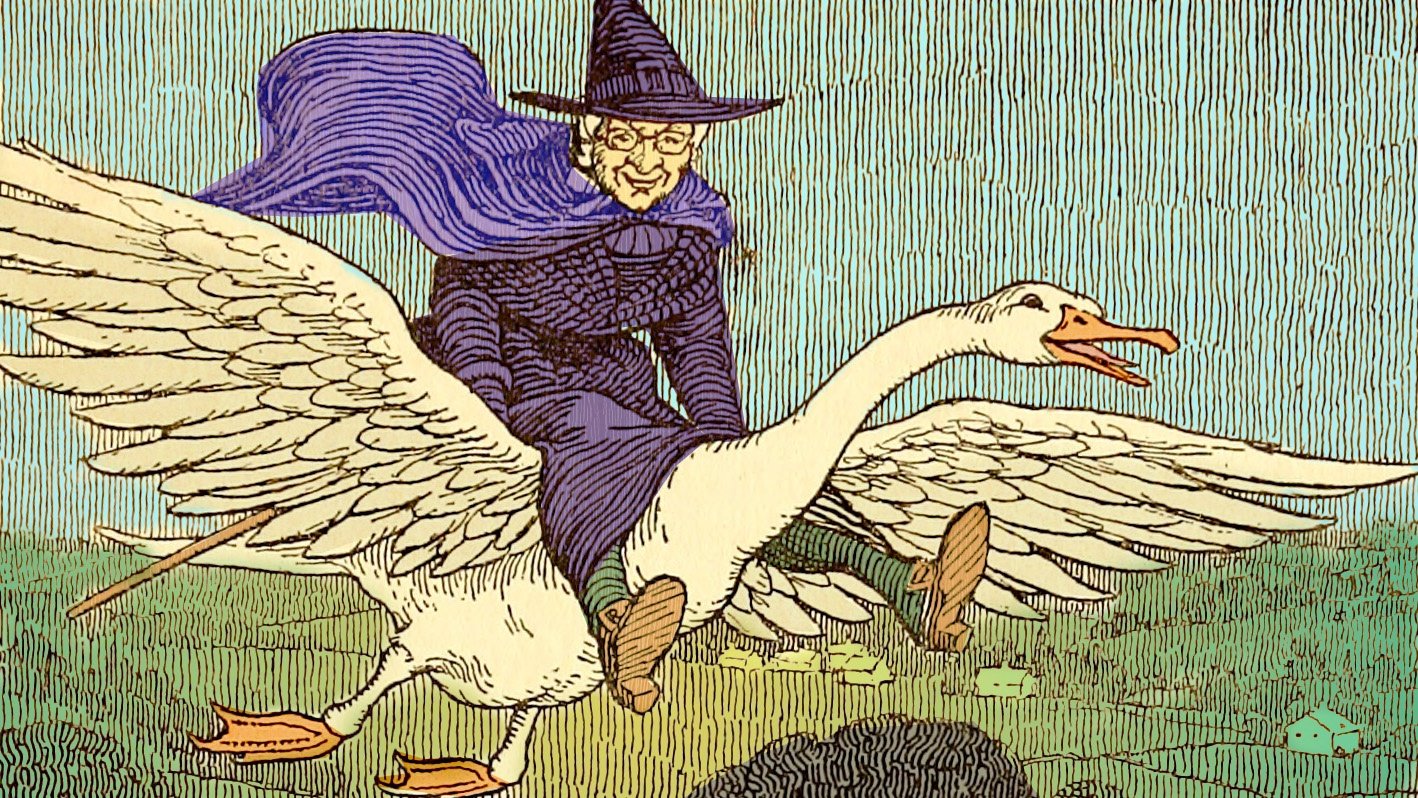
 As the summer wraps up, many families are savoring some precious moments of togetherness before the busy school year resumes. We’ve gathered a selection of pieces written for children—either to play themselves or listen to—that parents can appreciate just as much as their little ones. No matter your age, we’re sure you’ll enjoy these charming and often educational works. So pull up a comfy chair and take a listen with the whole family.
Maurice Ravel: Mother Goose Suite
Maurice Ravel originally wrote the Mother Goose Suite between 1908 and 1910 as a five-movement suite for piano four hands for the children of his friends Ida and Cipa Godebski. Ravel would often visit the family at their country house, devising practical jokes and making up stories with the children, Mimi and Jean. He dedicated the piano duet to the siblings and suggested they give the first performance of the work, but Mimi reportedly “froze” at the idea. Instead, two other young pianists, Geneviève Durony and Jeanne Leleu, premiered the work at the first concert of the Societé musicale indépendante in April 1910. Ravel expanded and orchestrated the suite in 1911 and even turned it into a ballet the following year. Today, the orchestral suite is the most popular form of the piece.
Aside from the “Prélude,” each movement of the suite tells a different fairytale, from Sleeping Beauty (“Pavane de la Bella au bois dormant”) to Tom Thumb (“Petit Poucet”) to Beauty and the Beast (“Les entretiens de la Belle et de la Bête”). There is also a sojourn to an enchanted forest full of fairies in “Apothéose—Le jardin féerique” and to an empress in the Far East in “Laideronnette, impératrice des Pagodes.”
Benjamin Britten: Young Person’s Guide to the Orchestra
In 1946, the British Ministry of Education commissioned Benjamin Britten to write music for an educational film called Instruments of the Orchestra. Britten could have easily phoned it in and written something simple. Instead, Young Person’s Guide to the Orchestra is of such high quality that it has become a concert work in its own right, appealing to young and old alike.
Britten borrowed the Rondeau from baroque composer Henry Purcell’s incidental music for the play Abdelazar or The Moor’s Revenge. The full orchestra introduces the stately dance theme. Each section of the orchestra then repeats it, beginning with the woodwinds and ending with the percussion. After a repeat of the main theme with full forces, Britten features the individual instruments within each section to highlight their unique characteristics. A series of highly contrasting variations on the main theme ensues, beginning with the highest instrument in each section down to the lowest. In the final section, Britten layers each individual instrument in a grand fugue. Each instrument enters in the order in which we heard them in the previous section, before Purcell’s rondeau returns in the brass.
Claude Debussy: Children’s Corner
Claude Debussy began writing the six short piano pieces that would become Children’s Corner in 1906, completing the work in 1908. Just three years earlier, he had welcomed his first child into the world, a daughter named Claude-Emma, or “Chouchou.” He dedicated Children’s Corner to her, writing, “to my dear little Chouchou, with her father’s tender apologies for what is to follow.” While he may have written the pieces for her to play one day, it is more likely he wrote them to entertain her as a toddler.
The set opens with “Doctor Gradus ad Parnassum,” referencing various piano exercises of that name written by piano pedagogues such as Carl Czerny and Muzio Clementi. It is full of scales and repeated figures, akin to these sometimes tedious exercises. “Jimbo’s Lullaby” evokes a child’s stuffed elephant, while “Serenade for a Doll” brings Chouchou’s other toys to life. Snow falls gently outside the child’s window in “The Snow is Dancing.” Next, “The Little Shephard” evokes the shepherd’s pipe. Finally, “Golliwog’s Cakewalk” reflects French society’s fascination with American music at the time with its syncopated dance rhythm and banjo imitations.
Sergei Prokofiev: Peter and the Wolf
In 1936, Prokofiev was commissioned to write a piece for the Central Children’s Theater in Moscow. The brief was to introduce young people to instruments of the orchestra while also promoting the ideals of the Soviet Young Pioneers, such as courage and resourcefulness. Like Britten, Prokofiev could have written something perfunctory. Instead, he produced one of his most enduring works, full of memorable tunes and orchestral color.
The narrator recounts a charming Russian folk tale throughout the piece. Prokofiev was given a text in rhyming couplets, but he was dissatisfied with it and rewrote it himself. The text has since been translated into countless languages and recorded over 400 times, with notable English-language narrators including David Bowie, David Attenborough, and Leonard Bernstein.
In the story, Peter, a Young Pioneer, is at his grandfather’s house in the forest. Wandering into the meadow, Peter encounters a number of animals, each represented by a different instrument, such as the oboe for the duck, clarinet for the cat, and flute for the bird. Peter’s grandfather (bassoon) scolds Peter for playing alone in the meadow when there is a wolf about, so he locks Peter in the garden. From behind the garden gate, Peter watches as the wolf (trio of horns) chases the animals and eventually swallows the duck. Peter runs and fetches a rope and eventually catches the wolf by the tail. A group of hunters (percussion) arrive, guns at the ready to shoot the wolf. Instead, Peter convinces them to take the wolf to a zoo in a grand victory parade.
Robert Schumann: Album for the Young
Robert Schumann wrote Album for the Young, Op. 68, in 1848 for his three daughters, Marie, Elisa, and Julie. The album contains 43 short pieces for piano, which are intended to be playable for beginning piano students. (This is in contrast with his Kinderszenen, or Scenes from Childhood, which are adult memories of childhood intended for advanced players.) Nonetheless, the album is divided into two parts, with the second part marked “Für Erwachsenere,” or “For more grown-up ones,” and containing more difficult pieces. As his wife, Clara, explains in her diary, Schumann composed Album for the Young because “The pieces usually given to children at their piano lessons are so bad, that it has occurred to Robert to bring out a collection of such little works himself.”
In the set, Schumann pares down his lush Romantic style to create short works of charming simplicity. Though less evocative than Debussy’s Children’s Corner, the pieces bear descriptive titles such as “Soldiers’ March,” “The Wild Rider,” and “The Merry Peasant Returning from Work,” suggesting vignettes that are up to the player to interpret. Most are lighthearted, though it wouldn’t be Schumann without hints of darkness, as in “The Poor Orphan” and “First Loss.”
Oliver Knussen: Where the Wild Things Are
Here’s a piece inspired by a beloved picture book that is probably already in your library. Where the Wild Things Are is a one-act opera by British composer Oliver Knussen (1952–2018). It is based on Maurice Sendak’s 1963 book of the same name, with a libretto, sets, and costumes by Sendak himself. Knussen composed the score between 1979 and 1983 as a commission from the Opèra National in Brussels. The opera premiered in 1980 under the title Max et les Maximonstres. The final version of the opera was first performed by the Glyndebourne Touring Opera in 1984 and made its US debut at the Minnesota Opera the following year.
Knussen’s sophisticated score is full of wit and charm that will delight young and old alike, winking at the audience with sly musical quotations. For instance, he uses the bell motif from the coronation scene of Mussorgsky’s Boris Godunov when Max is crowned the king of the monsters. In the opera, Max is sung by a soprano, while the monsters are sung by singers off stage. Actors inside the monster costumes manipulate the characters’ movements, and technicians in the hall control their eye and nose movements. The fearsome beasts, which stand nine to twelve feet tall, are made of Lycra stretched over an aluminum frame and covered in yak hair, bringing Sendak’s iconic illustrations to life.