
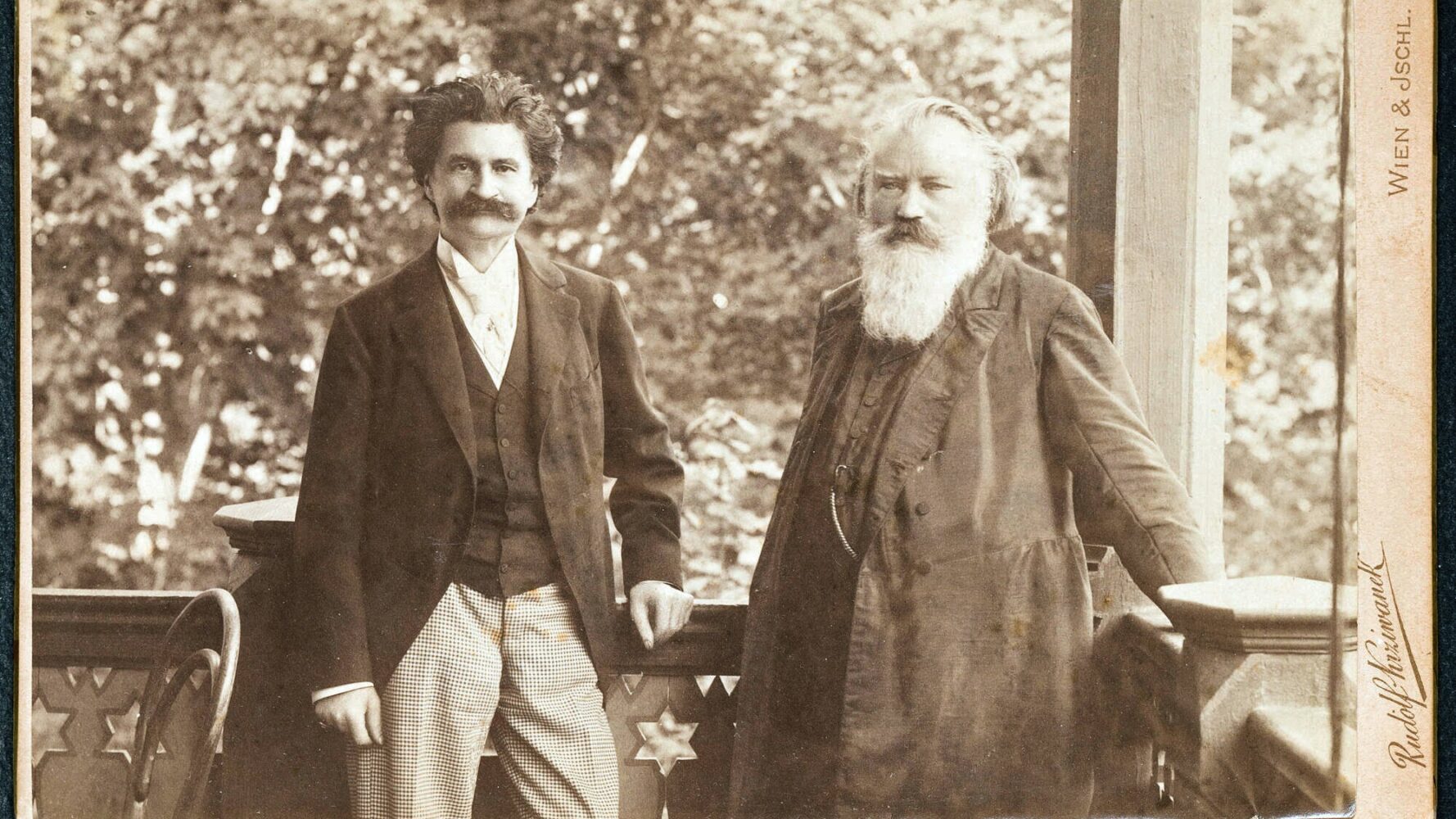
Johann Strauss II and Johannes Brahms in 1894 (Photo: Rudolf Krziwanek, Public domain, via Wikimedia Commons)
Johann Strauss II, also known as Strauss Jr., was famous during his lifetime as “The Waltz King.” Born on October 25, 1825, the Austrian composer published well over 500 dance pieces and several operettas that shaped the sound of Vienna.
Like his father before him, Strauss Jr. worked mostly in a subset of classical music referred to as “light music”. Yet his greatest contributions lie in the world of the waltz. The lilting dance melodies of Johann Strauss II catapulted the Viennese waltz into the upper echelon of popular music – a position it still enjoys to this day. It is a genre that many classical music fans discovered as children, thanks to pop culture references in movies, books, video games, and even other modern music.
One of the reasons why Strauss has a near-monopoly on the world of 19th century waltzes is that his compositions have withstood the test of time. They are deliciously simple while being meticulously thought out, orchestrated to perfection with nary a note out of place. It is the mark of a true master to make timeless art appear effortless.
This month, WFMT celebrates the 200th birthday of Johann Strauss II by asking WFMT hosts to share their thoughts about this iconic composer.
Oliver Camacho (Music Director):
It has to be either the “Voices of Spring” waltz or Adele’s "Laughing Song" (“Mein Herr, Marquis”) from Die Fledermaus. I remember hearing “Voices of Spring” as a kid watching The Three Stooges episode “Micro-Phonies.” I absolutely fell in love with that tune and the glamor of the opera singer hiding behind the curtain as Curly lip-synced for the audience. Years later, in high school, I was introduced to Adele’s "Laughing Song." An upper classman, none other than Chicago-based arts philanthropist Sasha Gerritson was competing and winning citywide vocal competitions with this aria. My chorus director at Lane Tech programmed this aria with chorus for one of our school concerts and when Sasha, then a high school senior, sang it for the capacity audience, it felt like for those three minutes in 19xx (redacted), she was the center of the universe.
Weston Williams (Host, Production Assistant):
I'm going to cheat a little and choose the “Emperor's Waltz” as arranged by Arnold Schoenberg! The composer we now associate with the avant-garde created a number of arrangements as a fundraising tool for his Society for Private Musical Performances. It's a fun historical reminder that the father of atonality and serialism shared the same city as the waltz master himself, and that collaboration between the two sides was (and is) a necessity for the preservation of the arts as a whole.
Cydne Gillard (Producer):
When I was a very young child, Johann Strauss II’s operetta Die Fledermaus taught me that beauty and humor can emerge from life's most ridiculous moments. One of the most memorable examples is “Trinke, Liebchen, trinke schnell…Glücklich ist, wer vergisst” (“Happy is he who forgets”), a fun drinking song from Act 1 of Die Fledermaus.
Watching orchestral string sections play pizzicato has also always amused me. Johann Strauss II and his brother Josef composed the playful “Pizzicato Polka,” a great example of arms in the air and fingers in unison plucking strings – so silly. I like Eugene Ormandy and the Philadelphia Orchestra’s performance.
Peter Van DeGraaf (Host):
Wiener Blut. Why? Strauss was influenced by so many things as he composed his many waltzes, but I like him best when he is inspired by what is closest to his heart: Vienna. And nothing sounds more Viennese to me than this waltz (yes, even more than the "Blue Danube"!)
Jan Weller (Host):
I tend to like the Schoenberg/Berg/Webern transcriptions of his waltzes, which have been recorded by various chamber ensembles. One of the reasons I like them is because they are from such unlikely sources! Examples include Schoenberg’s approach to Roses from the South, Wine, Women and Song arranged by Alban Berg, or Sweetheart Waltzes arranged by Anton Webern.
Dave Schwan (Host):
I like so many things by Johann Strauss, Junior, it’s hard to choose! However, his most popular pieces are all included. I became familiar with things like “Morning Papers” and “Emperor Waltz” on the record (the original LP) with the Chicago Symphony and Fritz Reiner well over 50 years ago. Those performances remain my favorites after all these years!
Kerry Frumkin (Host):
I love the "Blue Danube". I was able to spend some time in Vienna and for me this piece of music conjures up not only the great river (which is not so blue these days) but a culture of tranquility and beauty.
Kristina Elstner (Host):
For me, when I hear Johann Strauss II, I think - party time! From all of his celebratory orchestral dances, to hearing the thunderous applause after each Strauss work on WFMT’s annual broadcast of the Vienna New Year’s Concert… so much of his music fits the bill for an upbeat backdrop to any celebration. Especially when you want to impress attendees with your knowledge of classical music. I recommend the "Champagne Polka"!
Follow WFMT on Spotify and Apple Music!



.jpg)