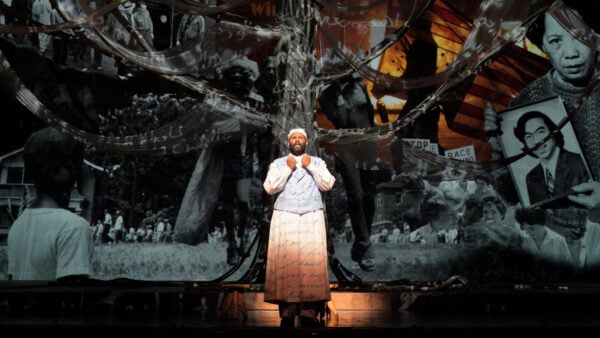
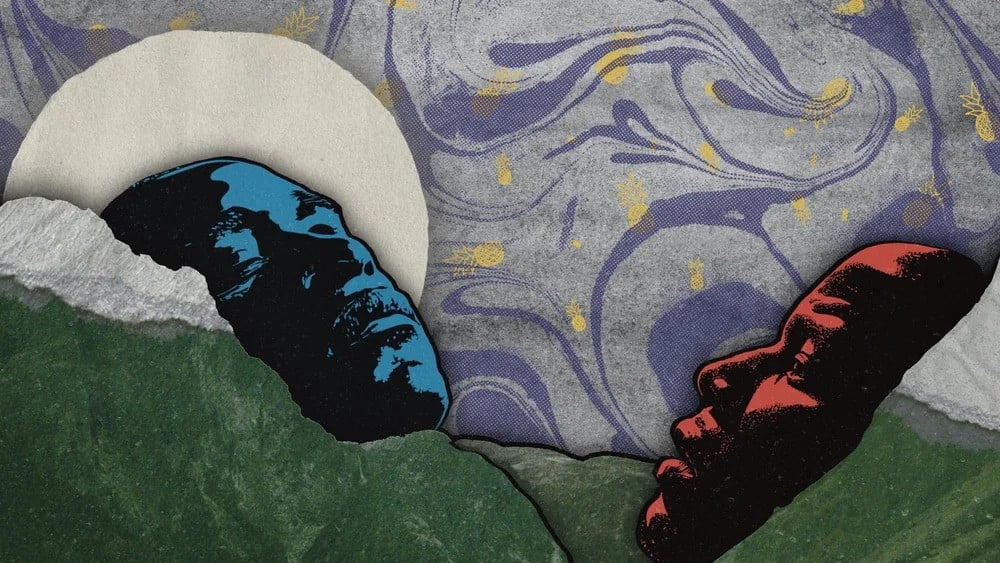
Chicago Opera Theater’s poster for Der Silbersee.
Written and premiered in 1933, Der Silbersee was Kurt Weill’s final work created in Germany. The political climate was rapidly darkening: the Nazi regime was consolidating power, and Weill – a Jewish composer known for his sharp social critiques – understood that censorship was inevitable. In response, he took a calculated risk, presenting a boldly satirical and politically charged “play with music,” thinly veiled as a surreal winter fairy tale.
The gamble was short-lived. Soon after its premiere, Der Silbersee was banned by the authorities, and Weill fled Germany.
Now, 93 years later, Chicago Opera Theater is bringing Der Silbersee: Ein Wintermärchen to Chicago audiences for the first time. WFMT spoke with COT General Director Lawrence Edelson and bass-baritone Justin Hopkins, who portrays the policeman Olim, about the work’s turbulent history and Kurt Weill’s enduring influence on American theater.
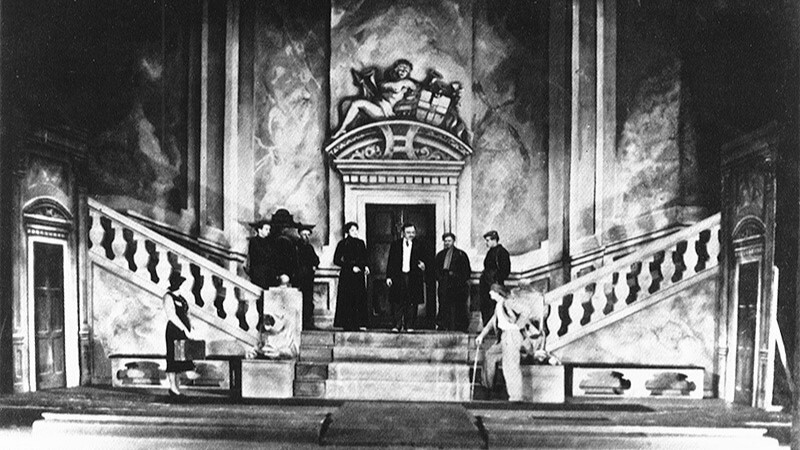
Olim’s castle, from the original production in Leipzig, 1933 (Photo: Kurt Weil Foundation for Music)
WMFT: Why was Der Silbersee so controversial?
Lawrence Edelson: Well to begin with, Weill obviously felt some concern about the work even prior to its release. They premiered it in three different cities on the same night, in part because they knew it would likely be attacked by the Nazi regime.
But the basic story is about a man who steals a pineapple because he’s hungry. He gets shot. The policeman who shoots him wins the lottery and buys a castle, where he nurses the robber back to health. But the robber doesn’t know that the man helping him is the same policeman who shot him.
It’s a wild ride, absurd and surreal, but the controversy comes from its moments of real satire. For example, there’s a fabulous song called Caesar’s Death, which speaks about the rise and fall of an authoritarian leader – and this was written in 1933 during the rise of Hitler. The subtitle for Der Silbersee (The Silver Lake) is A Winter’s Fairy Tale; it’s an allegory that gives you space to reflect on what’s meaningful and how we treat others.
Justin Hopkins: I think one of the main controversies of the opera is also how few people actually grapple with their conscience and come out a different person than they were before they confronted their status quo.
Even just looking at my character of Olim: at the beginning of the piece, he shoots a robber. And depending on the audience, Olim can be seen as either the hero or the villain. Someone could say, “yeah, he got him good” or even “he should have killed him,” but then another group would say, “no, that’s excessive force for somebody to be shot over a robbery.”
So we go on a journey with Olim as he grapples with this question: was this [the shooting] justice for someone stealing a pineapple? Through Olim, the audience gets to see a conscience evaluating itself, working itself out, and coming out better on the other side. You can see why it was banned so quickly after it premiered.
WFMT: How would you describe Weill’s musical language in this piece, and the way it changed after he immigrated to the United States?
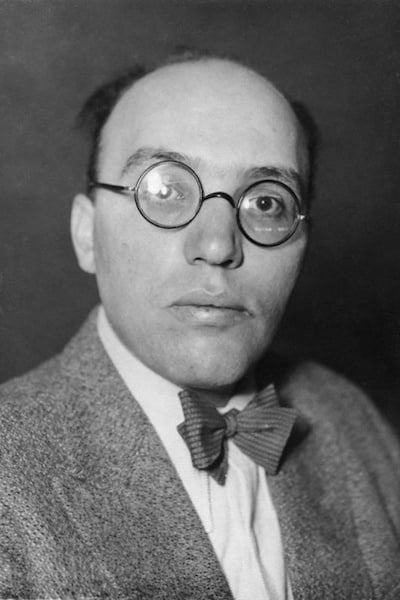
Composer Kurt Weill. (Photo: Bundesarchiv, Bild 146-2005-0119 / CC-BY-SA 3.0, CC BY-SA 3.0 DE <https://creativecommons.org/licenses/by-sa/3.0/de/deed.en>, via Wikimedia Commons)
Hopkins: Weill’s language in general is so unique. When you hear Kurt Weill, you know it’s him, and that can be said of so many of the greats: Mozart, Beethoven, etc.
There’s a very stark sound to his early pieces. Oftentimes the orchestra is relatively small, but heavy on the woodwinds, lots of clarinets, at times almost Klezmer-music sounding. There’s a lot of Greek chorus in the early Weill pieces – and you’ll hear this in Der Silbersee, a choir that responds to the plot in a way that acts as the conscience of the characters.
When he came to America, he adapted more of an American influence. For instance: I sang Lost in the Stars, one of his final pieces before he died, and it’s so soulful. It has so much, not only American, but also South African influences, since the story is based in South Africa. He was really the type of composer who adapted and still retained a unique musical identity.
Edelson: There’s a huge difference from the work that was done in Germany, and the work that was done here in the United States. But Weill was almost always political. His first real major Broadway hit Johnny Johnson was a pacifist piece – an anti-war work that premiered in 1936. Then he moved into Street Scene, one of the great American operas.
Weill really helped to change the shape of Broadway. He was a chameleon, and he embraced and adopted his homeland.
WFMT: What relevance does Weill’s theatrical work hold for modern audiences?
Edelson: We have a history at COT of not shying away from material that speaks to contemporary American society. A piece like Der Silbersee was written in 1933, but is as contemporary in terms of its relevance and storytelling as anything written today.
The underlying theme of Der Silbersee is: how can we find reconciliation and hope in a fractured world? And the United States is a very fractured place right now. So this idea of reconciliation and finding common ground with people…I mean, I can’t think of anything more important.
Also, being here in Chicago, at the epicenter of the attack against immigrant communities, is heartbreaking. So to be able to celebrate the contribution of immigrants to American music and our city is very meaningful for us.
I’m a huge fan of the work of Kurt Weill, but also his own story as a Jewish artist who fled Nazi persecution, came to the U.S., and enriched its musical landscape. It speaks very powerfully to the present moment, when immigration is often framed in really reductive and dehumanizing terms.

Concert poster for COT’s “In America’s Embrace”.
WFMT: Speaking of programming, I hear COT is doing some supplemental programming to support Der Silbersee’s premiere?
Edelson: Keeping in mind the 250th anniversary of the United States this year, we’re presenting a concert called In America’s Embrace on January 18 that traces how immigrant composers have enriched American cultural life. Understanding the breadth of different composers writing music that we identify as being American is surprising. A lot of people who are on sort of the anti-immigrant side of the conversation probably don’t even realize that so much of what they love is by immigrants. Composers will range from 20th century staples like Irving Berlin to those who have just come over to the United States recently.
We’re also doing a discussion (with musical excerpts) on February 9 in collaboration with the Illinois Holocaust Museum and Education Center. The program is called 1933, The Turning Point: Our Oppression and Resistance, and focuses on how 1933 – the year Der Silbersee premiered – marked a profound rupture in the history of both Europe and the arts at large. That was the year that Hitler was appointed Chancellor of Germany and ushered in the Nazi dictatorship, which not only unleashed this systematic campaign of anti-Semitism, but also censorship and cultural control.
Both concerts are our way of making that connection to what we’re putting on the main stage, in a way that deeply aligns with our mission. All of us have the ability to influence only what we have direct responsibility over. As the leader of Chicago Opera Theater, I can impact what COT does, so I want to ensure that we are speaking to our values.
WFMT: What is the message you’re hoping people will take away from this story?
Edelson: I’d rather not frame it in terms of lessons, because I think that’s a great way to scare people away from coming to the opera. You can’t tell how anyone is going to respond to a piece; you can only set up the environment for them to have a response right?
My job is to create a world and give them the opportunity to experience the story. Because quite frankly, a piece like this can resonate with you no matter where you are on the political spectrum.
So – come to the opera and be engulfed in this fairy tale. It’s a real roller coaster with amazing music that allows you to find parallels, despite the fact that this piece was written almost 100 years ago in a different country.
We’re still dealing with the same things: hunger and food insecurity, poverty and political power. Those are all things that haven’t gone away. You don’t go to the theater to be lectured – but I do believe you can go to the theater, be entertained, and have a transformative experience.
Der Silbersee makes its Chicago premiere March 4-8, 2026. For more information, visit chicagooperatheater.org