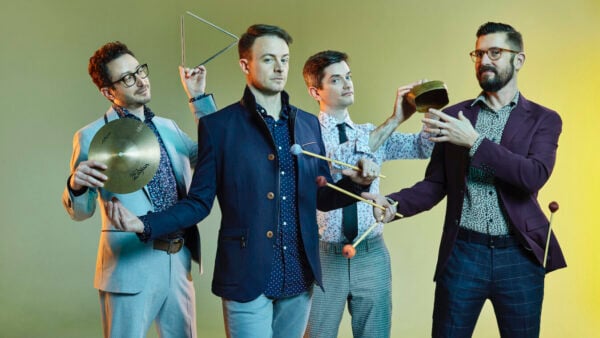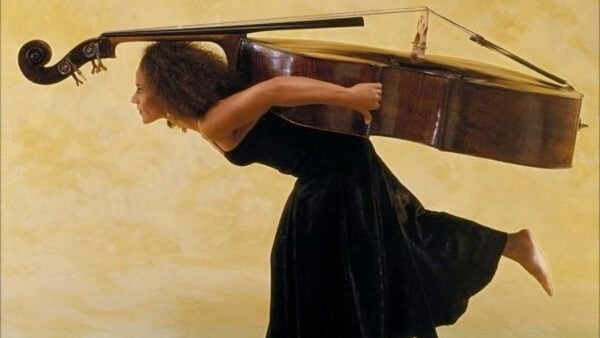
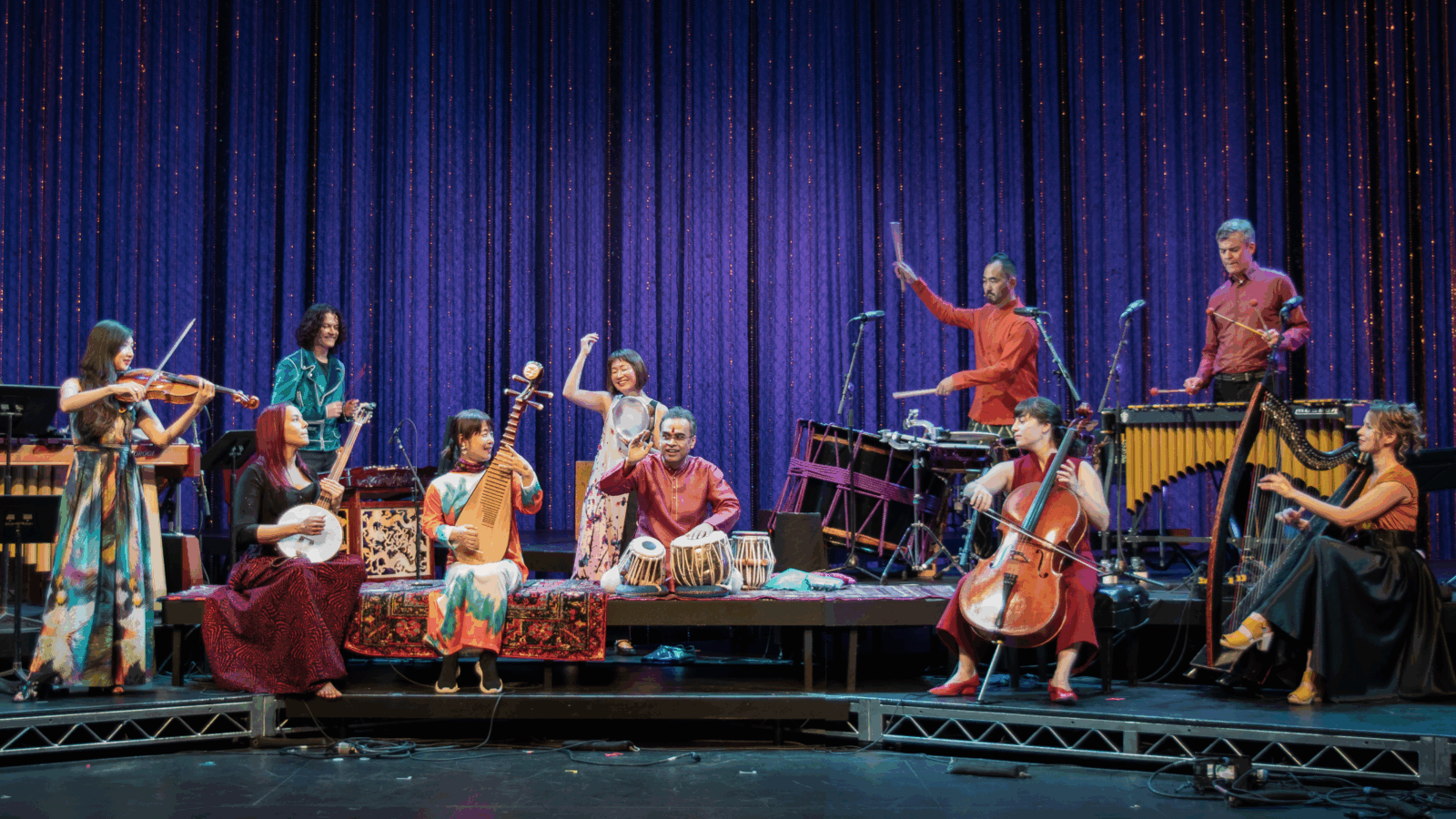
Silkroad Ensemble publicity photoshoot for 2026 Sanctuary tour. (Photo: Adam Gurczak.)
When Rhiannon Giddens came up with “Sanctuary” as Silkroad’s 2026 theme, she couldn’t have imagined just how relevant the phrase would become. “It’s like a hot keyword now, right?” jokes Haruka Fujii, Associate Artistic Director of the multinational ensemble. “Many other artists are also coming up with projects around the idea of sanctuary. But apparently, that’s what society is really looking for.”
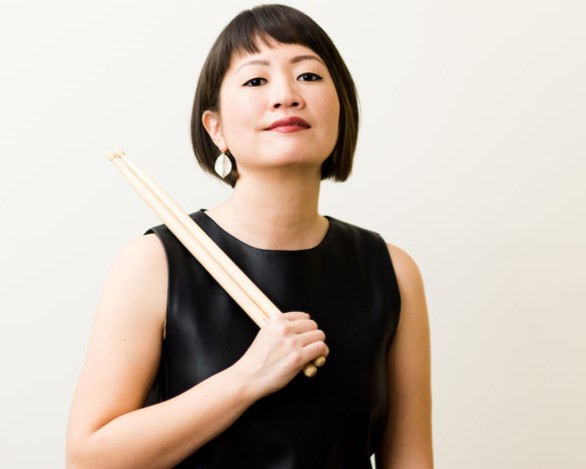
Haruka Fujii (Photo: Chelsea Gregory Photography)
Percussionist Haruka Fujii has been with the Silkroad Ensemble for 15 years. A veteran of the group, Fujii was born and raised in Japan and moved to the United States in 1998 to further her musical studies. When she joined Silkroad in 2011 under the direction of Yo-Yo Ma, she still viewed herself mostly as a Western classical musician with a focus in contemporary music. But the idea of one ensemble, made up of skilled musicians using their cultural heritage to create something new, started changing her mindset. “Until Silkroad, music was something I used to express my own interpretations,” says Fujii. “My experience at Silkroad has changed that view. Now I look at music as a device of connecting to the world: how can I connect to the rest of the world through music, and what can music do for them?”
Community has always been integral to the ensemble, but it’s never been as heavy a focus as these months leading up to their Sanctuary tour. Whereas previous programs would mix existing compositions with arranged folk songs, the program this time is bound by improvisation – a task that can only be accomplished when musicians are in the same room. For a group whose members are scattered worldwide, finding time to be in the same place at the same time becomes an incredibly intentional act. “We’ve been fortunate to have multiple workshops organized by office staff and board members. They make sure artists have an opportunity to get together in person and exchange ideas about songs, dances, history, or different backgrounds,” says Fujii.
She continues, “Throughout multiple workshops we ask members to bring different stories inspired by the theme, and brainstorm how each idea could bloom. Later, Rhiannon and I would get together and figure out what ideas can be put into an actual program.” Cellist Karen Ouzounian, also a longtime member of the Silkroad Ensemble, sees this collaboration as distinctly different from the approach taken by usual large-scale ensembles. Meetings require active participation, rather than a passive reading of the music. “On a personal level, it stretches me musically: whether that’s improvising more, or exploring new melodic or rhythmic and metric material. It’s also a little microcosm of what is possible to build when we bring our open hearts and ears into a room,” she mentions. Even when miscommunications arise, the group uses music as the language of resolution.
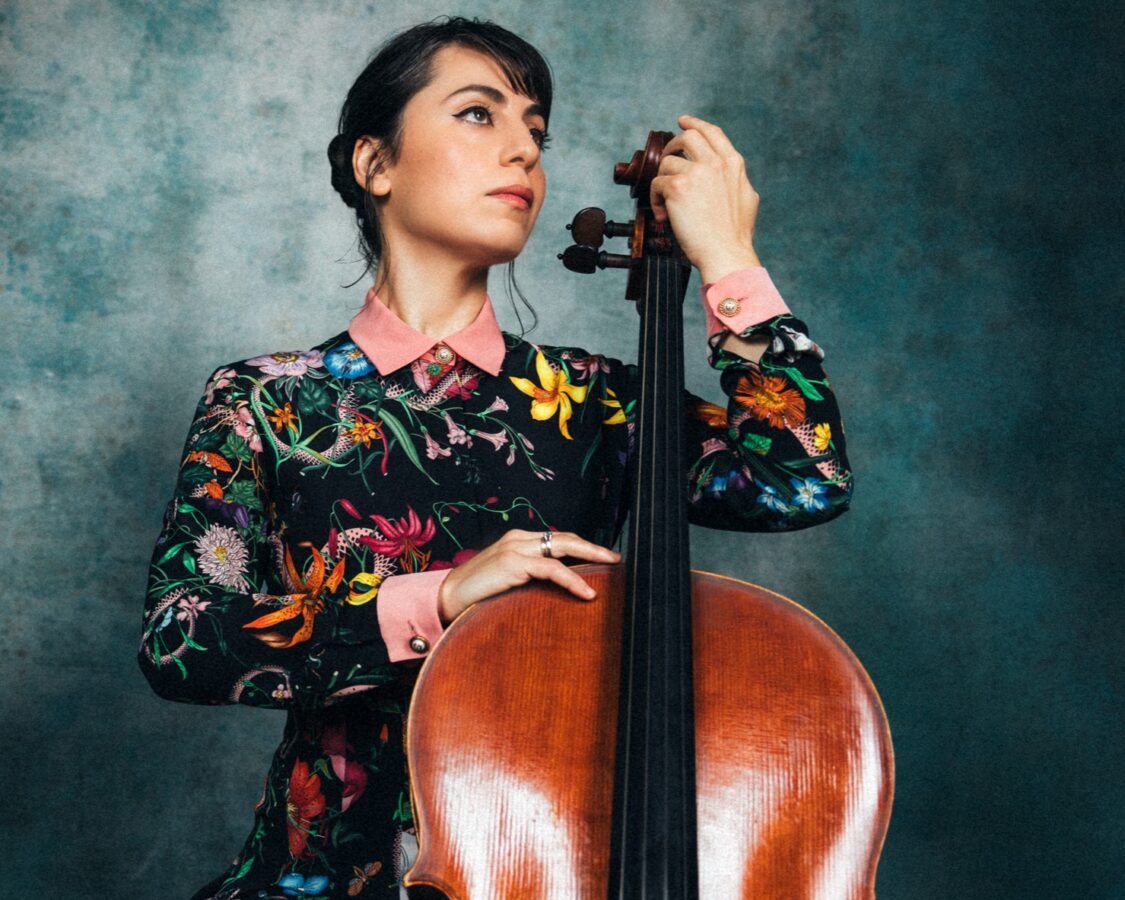
Karen Ouzounian (Photo: EbruYildiz)
Ouzounian will be bringing parts of her Armenian heritage, including her own family’s story, to concert halls this spring. Fujii is bringing a Japanese song on the verge of being lost to time, currently being kept alive by one 92-year-old traditional folk singer. Representations from the Maranao people, Sicily, and the United States are also included on the list of the music that will be performed, even as the setlist is adapted to each city on the tour.
For the first time, Silkroad is also taking the theme of “sanctuary” directly into communities they’re visiting. It’s an exciting effort that the ensemble has been striving to do for years, but it’s never before been fully realized, mentions Fujii. “For this tour, we made sure to set aside a few days in each city to find a community with the same vision and interests, with whom we could exchange ideas.”
In Chicago, this collaboration will be realized through a partnership with local string group D-Composed. The group’s director Kori Coleman has ties with the Harris Theater where the Silkroad Ensemble is performing, and has been in touch with the group for a long time. It was a no-brainer type of collaboration, says D-Composed violinist Khelsey Zarraga. “Concerts in community spaces… that’s our bread and butter,” she explains with a laugh. “To have their [Silkroad’s] theme be so aligned with ours, we thought it was a great chance to bring about a fully improvisatory experience.”
Both groups agreed that the structural outline for the March 13th show at the Land School will revolve around the idea of sanctuary as a physical space. As the ensemble moves throughout various sections during the program, the audience will be called upon to help build and flesh out the different rooms. “We love inviting the audience to be a part of our shows as much as we can,” adds Zarraga. “[This time] we’re getting prompts in real time from the audience about what sanctuary means to them and using that to guide our music.”
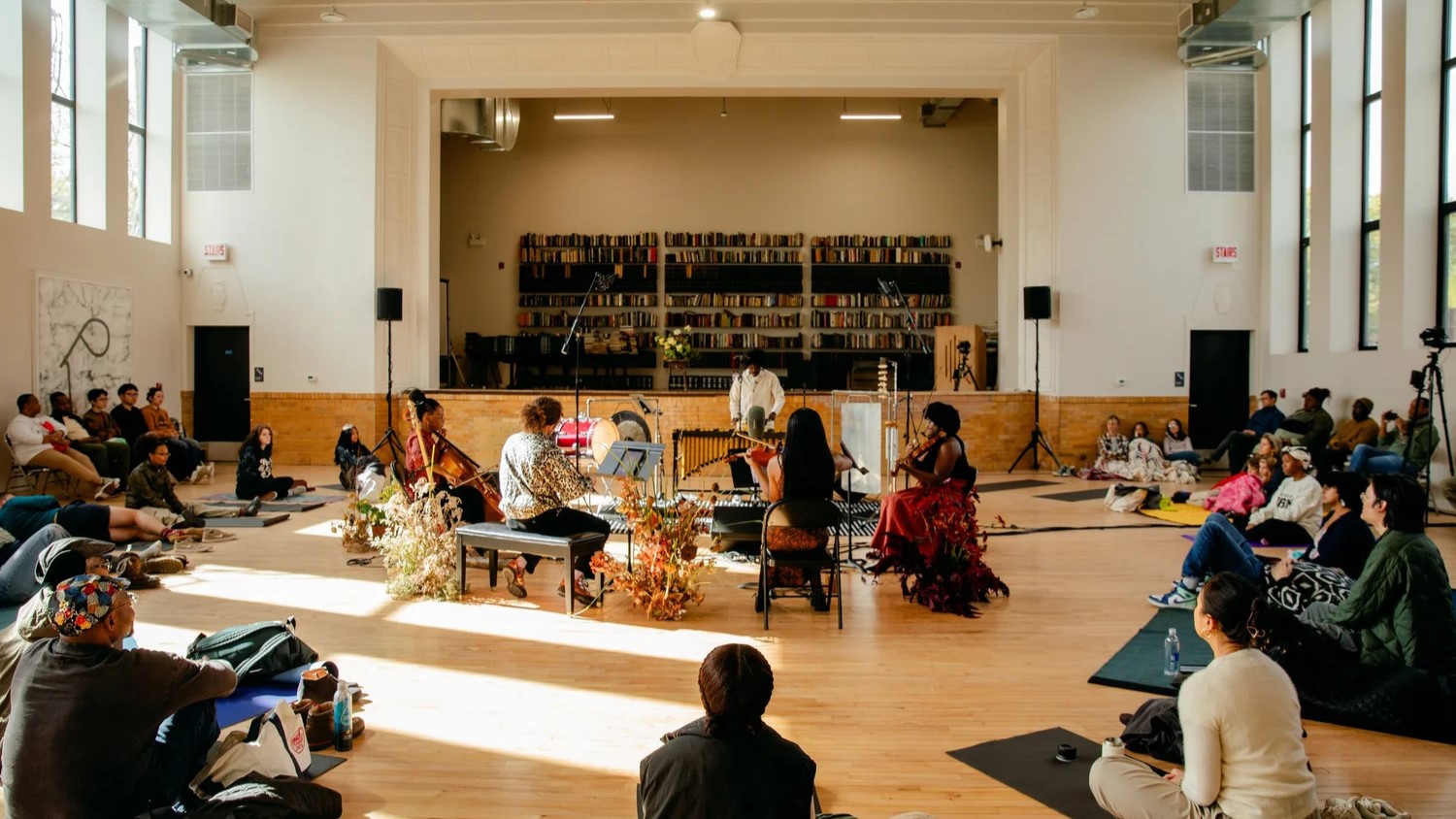
D-Composed performing a concert at the Land School called “For the Plants.” (Photo Credit: Ashley Mia)
As the Silkroad Ensemble spends extra time in each city on tour, it also allows for an unexpected benefit: more of a chance to soak in a city’s culture. While both Fujii and Ouzounian call deep dish pizza “a monstrosity” with a mixture of laughter and awe, there are elements of homecoming as well. For Ouzounian in particular, Chicago holds significant musical importance: she studied at the Steans Music Institute for several summers, and the group is even producing a new show of hers during the next Ravinia Festival season.
Still, as the group tours the United States, the musicians continue using “sanctuary” as their guiding star, aligning personal experiences with the various communities they are visiting. “For me…musical sanctuary can be a lot of things,” mentions Ouzounian again. “The music of my friends, the music of my colleagues, or the music of my family. It’s hearing old recordings of Armenian musicians, either in Anatolia or in Lebanon where my family ended up after the genocide, or field recordings of Armenian musicians in New York in the 1940s. It’s the choir singing in an Armenian church, but it could also be chamber music. At the end of the day, it’s all about music from the heart.”
For Haruka Fujii, the sanctuary is Silkroad itself. “Throughout these 15 years,[I’ve learned] people are ready to make something beautiful out of what you’re sharing.” She continues, “Sanctuary is a place you feel safe: a communal space with people who make you feel it’s safe to be there. We’re hoping that, through this project, the concert hall itself is going to become such a place: a place to experience, learn, and be part of this music, whether it’s singing or other ways. Hopefully we can connect with people, and let our music speak for itself.”
The Silkroad Ensemble will be in Chicago March 13-15. Learn more about their various concerts on their website. Interviews have been edited for length and clarity.