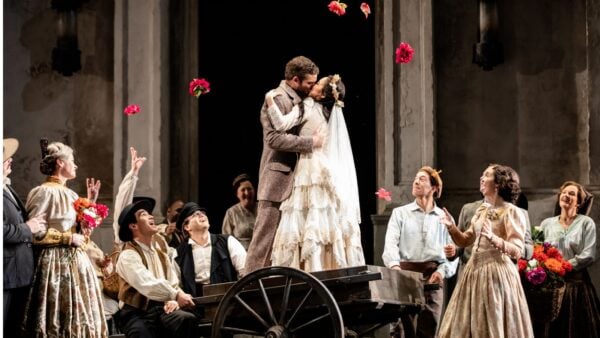
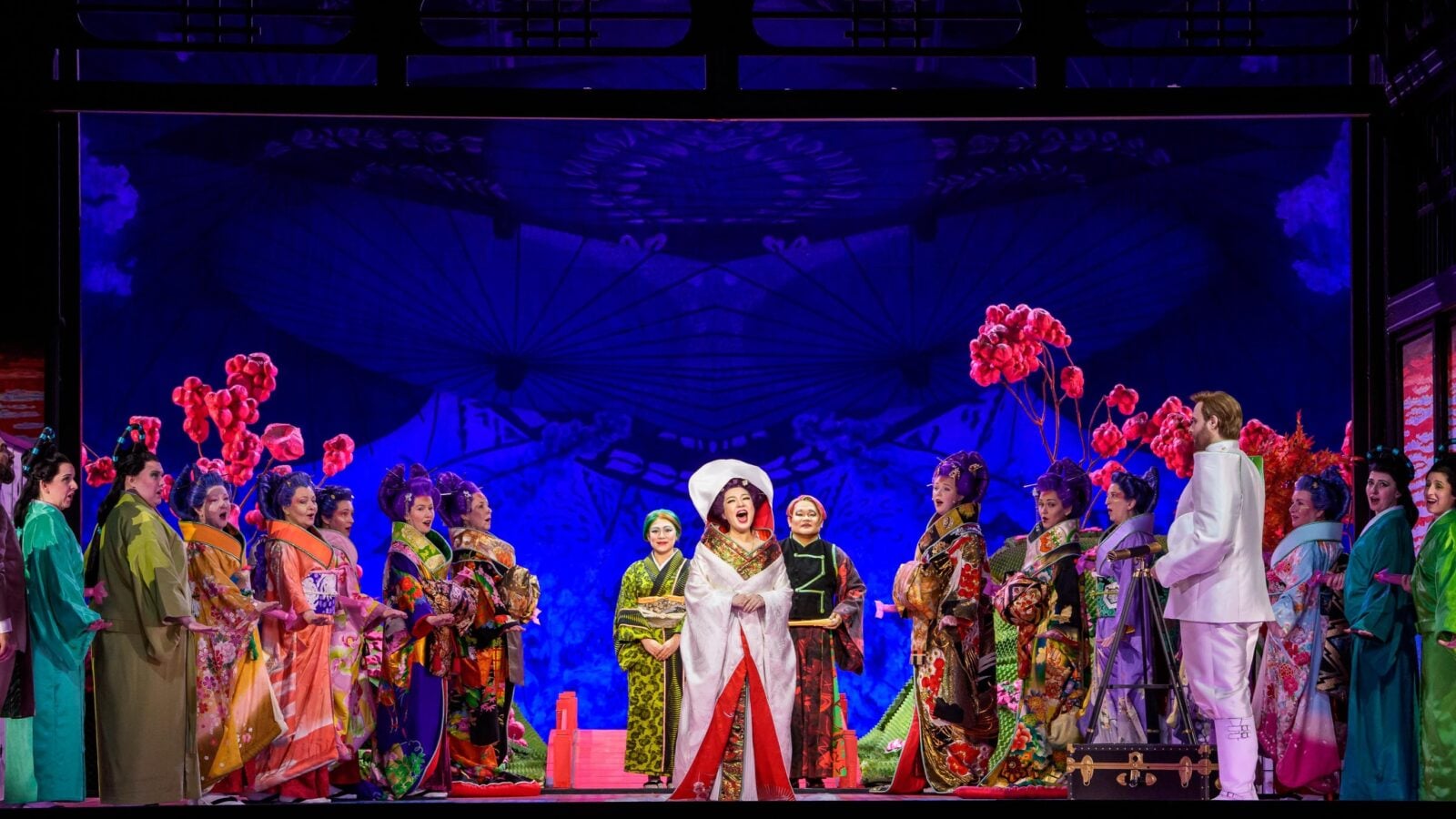
Madama Butterfly dress rehearsal scene at the Lyric Opera of Chicago. (Photo: Todd Rosenberg)
Matthew Ozawa, a prestigious Asian American opera director who now serves as Chief Artistic Administration officer at the Lyric Opera of Chicago, has built a career staging productions at major companies across the country.
Along the way, Ozawa has grappled with mixed feelings about some of the genre’s cornerstone works – particularly Turandot, The Pearl Fishers and Puccini’s Madama Butterfly. In her book Opera Wars, Caitlin Vincent outlines how contemporary directors have navigated these tensions: some stage the works as written, while others, like Aria Umezawa, revise librettos or remove key scenes altogether.
In his own journey with Madama Butterfly, Ozawa arrived at a question: what if technology could help reframe the story? He spoke with WFMT about how virtual reality – paired with a deep love of the genre – might help audiences see opera’s most familiar works in a new light.
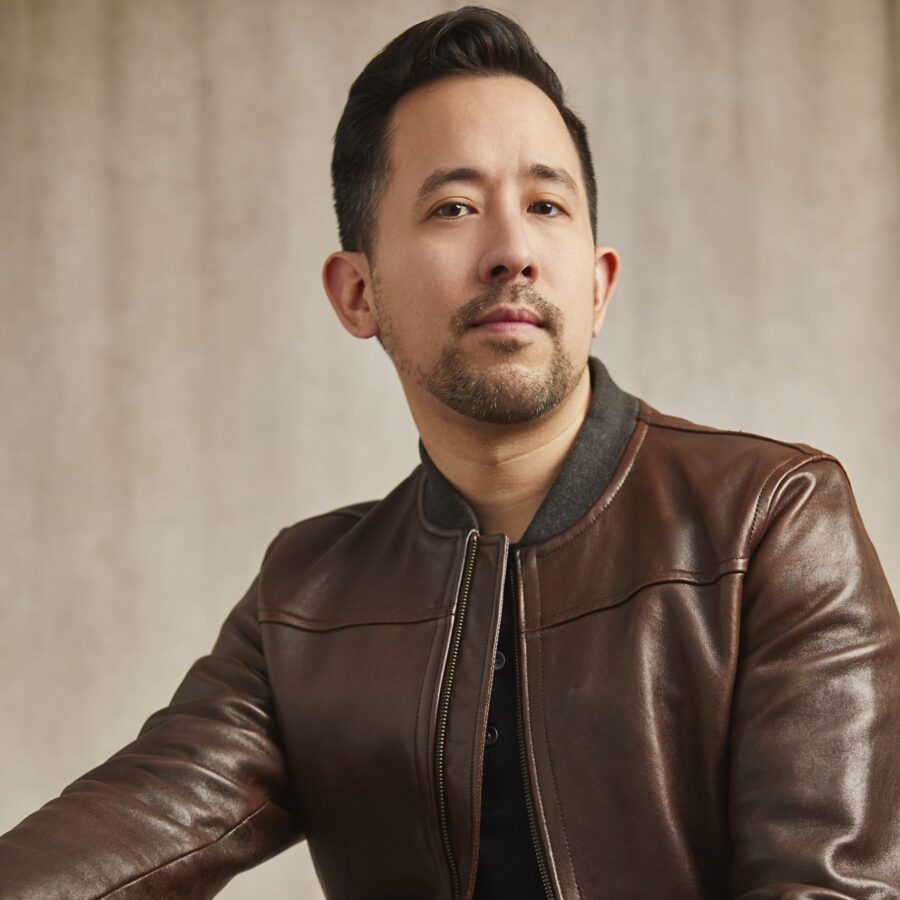
Matthew Ozawa (Photo: Jon Wes)
WFMT: What has been your relationship to Madama Butterfly throughout your professional life?
Matthew Ozawa: It’s been long. I’ve been directing productions of Butterfly for the past decade: this will be my fourth production, and the fifth revival of this current iteration.
As a fourth-generation Japanese American, the piece has always resonated with me in different ways – some more comfortable than others. My first interaction with Butterfly was a very traditional production. There were no Asians; everyone was in yellowface, there was a lot of stereotyped shuffling and people doing squinty eyes. People would speak pidgin Japanese to me, even though I had never spoken to them in Japanese prior.
The piece is beautiful. It has gorgeous music. The story is extremely impactful. But I’ve always had issues with certain aspects of the work, especially as they relate to American imperialism, the nature of ownership, and the disposability of a human. The main character is only 15 years old, after all.
I actually accepted the offer to direct a traditional Madama Butterfly first in order to dissect what was making me uncomfortable. Was it the work itself, or the way it has been presented? After I found my Japaneseness within the East-West conflict and the dramatic arc of the characters, I realized it was the latter.
WFMT: What inspired this particular production?
Ozawa: I’ve directed several traditional productions and was slated to do another one for Cincinnati Opera when the pandemic hit. It really ripped off my rose-colored glasses regarding opera, this piece and my position overall.
At the time, I had already been turning down a lot of Pearl Fishers, not wanting to use my Asian name to put a green light on things. But I’ve always felt an immense duty to say yes to Madama Butterfly because I’m Japanese American. So I pulled out of the Cincinnati production and said the only way to get me to direct was an entirely new production with an all-female, Japanese design team. They said, great, let’s do it, and brought on a consortium of other companies as co-producers so that it could travel and be financially sustainable.
Their only stipulation was to ensure the entire opera was kept intact, with no music or text changes, I imagine because there were many Asian Americans taking on the work and changing or interpreting it further at this point.
My goal was to create a production where those who love the traditional could retain that love, while making sure those who have felt distanced by the opera feel this is their story, too. It was like walking on a tightrope, creating a production that could bring everyone to the table.
It was early in the brainstorming when the team said they didn’t feel like Butterfly represented them, and found the suicide problematic as Asian women. Because they couldn’t see themselves in her, the work felt like a fantasy. That word – fantasy – became the bedrock of the concept: a production to help the audience understand this opera is a fantasy, someone’s version of Japanese people and women.
All of Puccini’s source materials were written from a Western male perspective. So from there, we elaborated: perhaps this is a modern-day American man obsessed with all things Japan – anime, manga and gaming. He’s lonely. He’s disconnected from humans in life, so he connects through virtual reality. And Madama Butterfly becomes the game he plays.
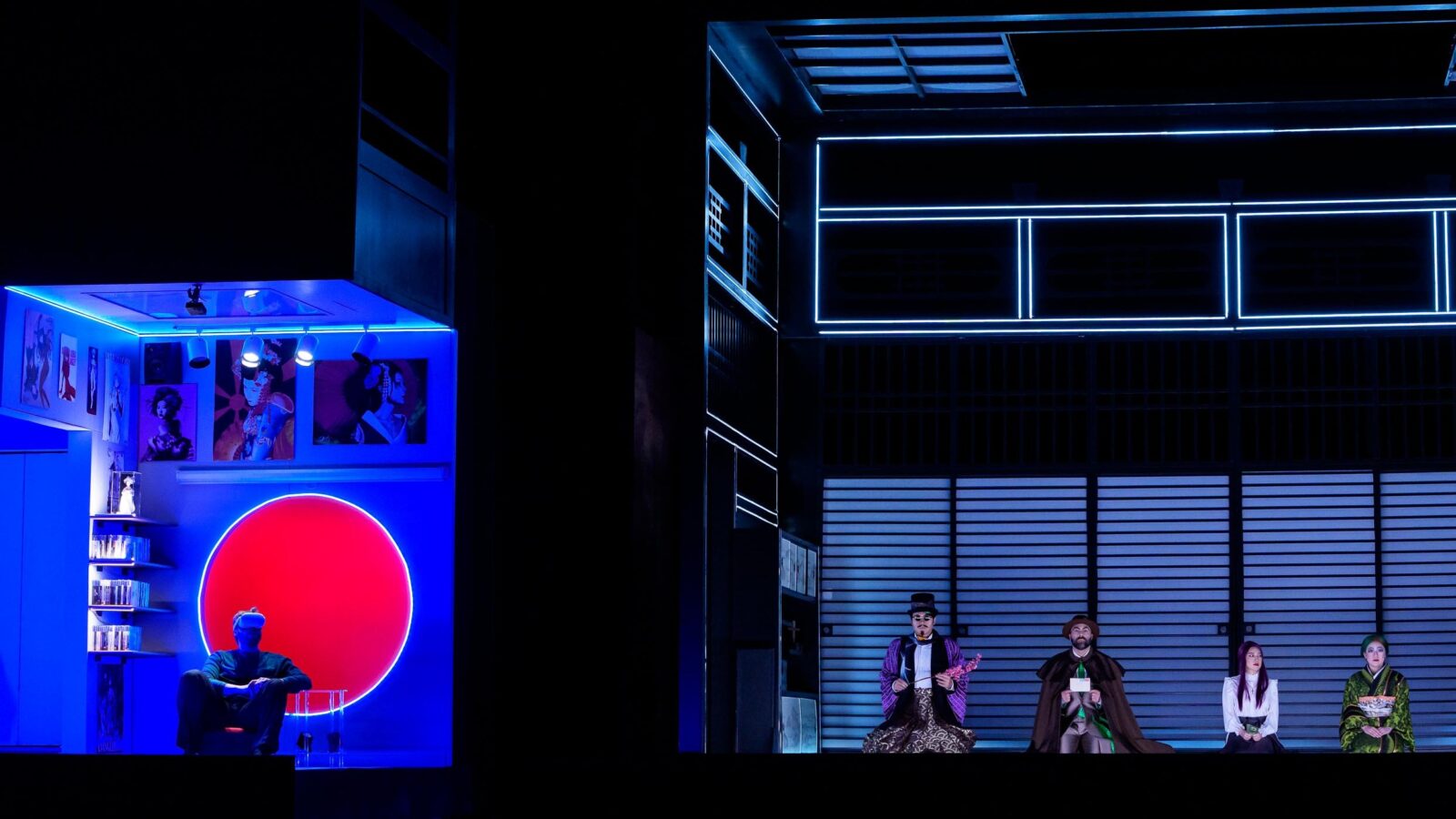
Madama Butterfly dress rehearsal scene at the Lyric Opera of Chicago. (Photo: Todd Rosenberg)
WFMT: How does modern technology (VR in particular) help reframe the story?
Ozawa: We wanted something Pinkerton could actually step into and play. The idea of a VR headset immersing you in an entirely different world to the point of not seeing your surroundings – it allows us to experiment with who is playing the game and why.
The fantasy allows us to create nods to Japan while ramping them up. For example, all of the costume fabric was sourced in Tokyo and Kyoto, but the kimonos have very high collars and the wigs are purple and blue. They feel geisha, they feel Japanese, but they are not.
It also allows for any person to be in the chorus. Historically, that has always been the hardest thing going from city to city. There are usually not enough Asians to fill the chorus, yet they’re all meant to be bowing and acting Japanese. The fantastical element allows everybody to wear these clothes as if they were in a Monet or a Degas painting.
Now fast forward to 2026. This is the fifth time we’re doing this production, and virtual reality is much more prevalent in our society. People know what a non-reality experience feels like, and some even relate to AI characters having a relationship with the real viewer. That is informing this production even more this time around.
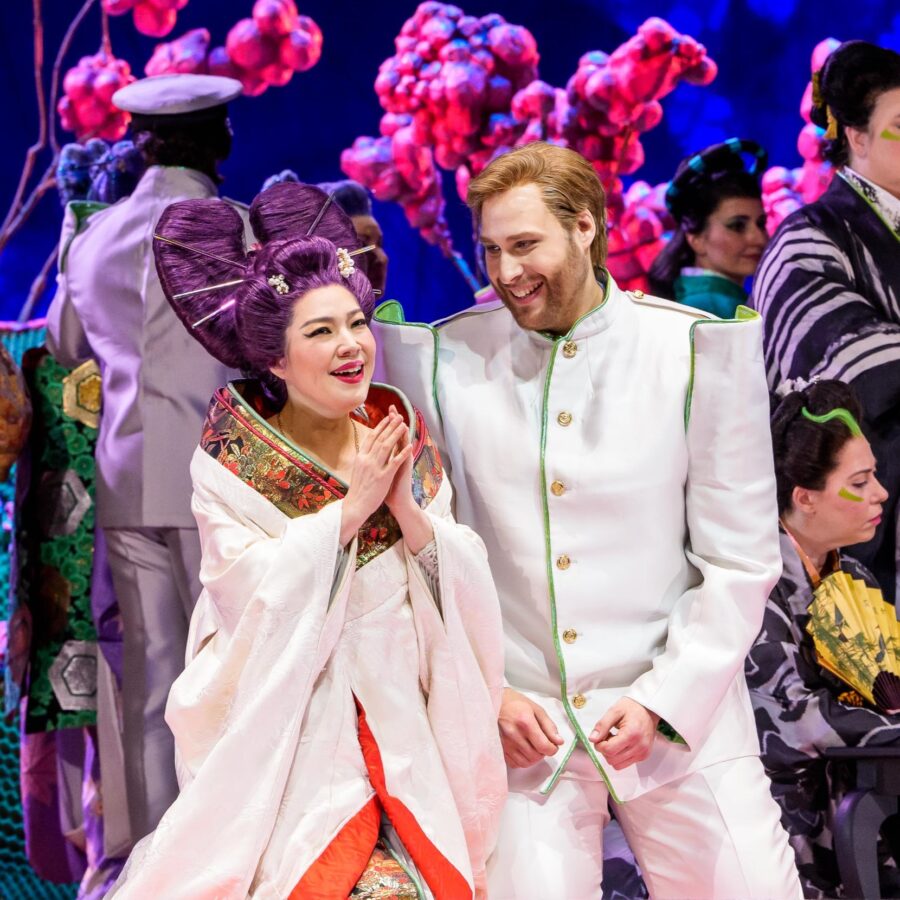
Karah Son and Evan LeRoy Johnson at the Madama Butterfly dress rehearsal, Lyric Opera of Chicago. (Photo: Todd Rosenberg)
WFMT: What still resonates with you after all these years of producing Butterfly?
Ozawa: There’s something gorgeous about the way Puccini orchestrated the opera. I’m deeply enamored by moments like the humming chorus going into Act III, for example.
There’s also all this additional material that I find extremely interesting. In reality, there are five versions of Madama Butterfly. The standard everybody knows is Puccini’s fifth edition: the initial version at La Scala was an enormous failure.
What I have done in our production is pull music from Puccini’s “Brescia” (second) version and insert it into the standard, which does a few things. First, it amplifies key themes: the East-West conflict, Pinkerton’s more racist views of the culture, Japan viewing the West as barbarians.
There’s also Kate Pinkerton, who usually only has three or four lines. In this version, she has an entire scene with Butterfly that gives her dimensionality and shows the complexity of her position. You see these women trying to find commonality upon realizing their fates are in the hands of one man. It is an extremely powerful scene that audiences are completely swept away by – especially those who know the opera.
The second reason I’ve added these inserts is to avoid folks becoming complacent. Those who love the tradition know this opera so well they could sing the entire thing. The inserts force them to be awake: to witness the opera as if for the first time. I’ve been told by many that people leave blown away by the beauty of the production, and understanding its more problematic aspects.
Madama Butterfly runs at the Lyric Opera from March 14 through April 12, 2026.
This interview has been edited for length and clarity.