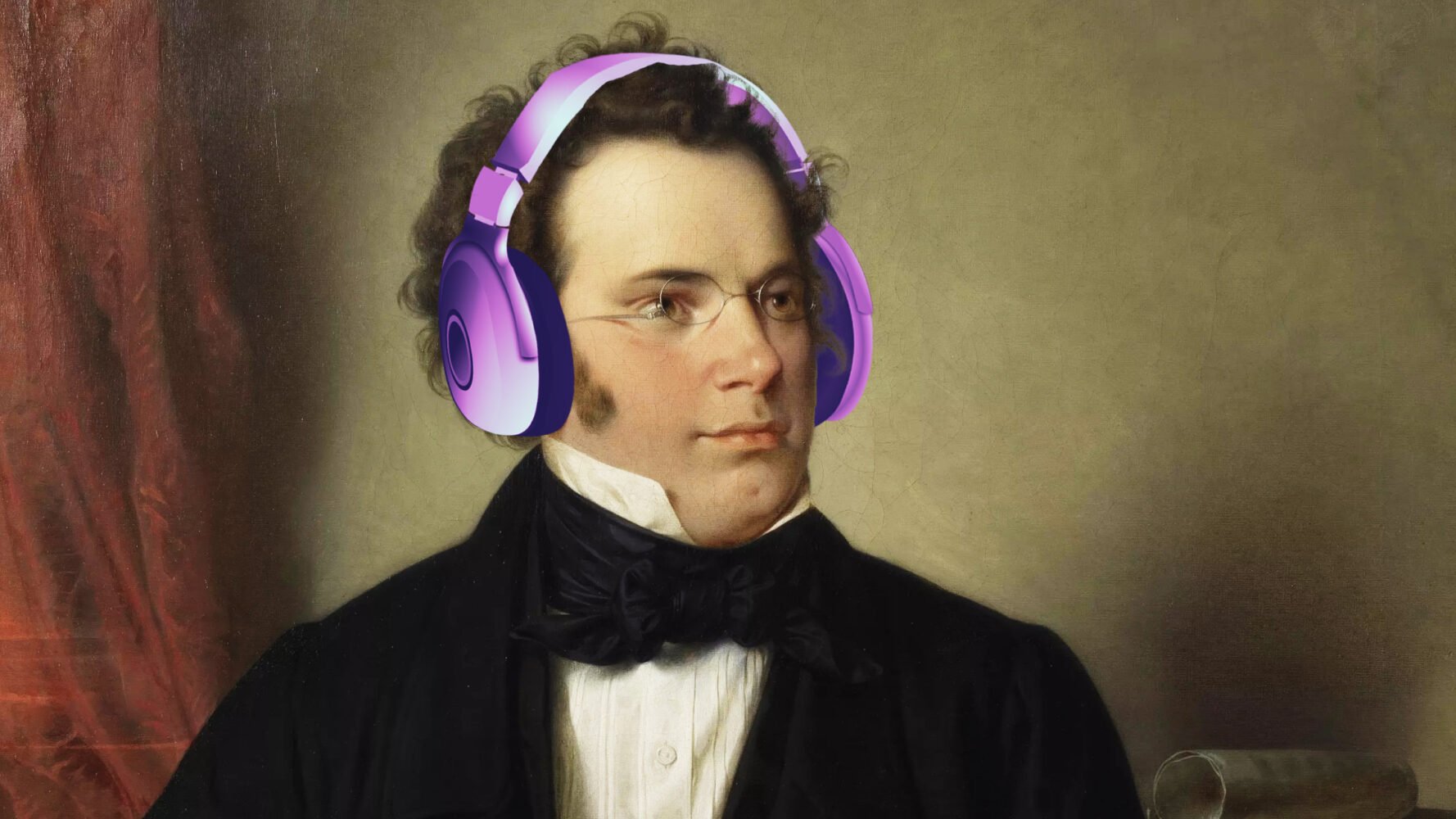
Franz Schubert wrote his fair share of earworms...
Pop songs often have a “hook,” or a repeated idea that gets stuck in the head. Among songwriters, it’s an important element of writing a hit. Think of a few of your favorite songs—is there a certain bit that makes it instantly identifiable? An earworm you just have to play on repeat? If so, that’s the hook.
Classical music can also have that earworm quality, but those hooks are more often overlooked as part of what makes some pieces especially memorable and beautiful. You’ll probably never learn about hooks as part of a standard classical music education—perhaps it seems too commercial, even disreputable, to be acknowledged in the concert hall. But in truth, hooks are a time-tested and versatile technique. On one end of the spectrum, they can create a feeling of fun and jauntiness, while on the other, they can be haunting and sublime.
Hooks are tricky to discuss because they can’t be picked out as any single thing on the music page. Instead, they seem to emerge from an interplay of melody, harmony, and rhythm—almost like a dark art. There’s no formula for writing one, but some frequent elements include distinctive melodic leaps, rhythmic repetition, and chord progressions with a feeling of circularity or inevitable return.
In the end, hooks have a qualitative nature that simply has to be experienced. So what might this sound like in classical music? Here are ten selections, each with an earworm quality that establishes a unique musical identity and opens an expressive world. These hooks will stay with you—drawing you back to these pieces time and again.
1. Bach: Gigue from French Suite No. 5
J.S. Bach could write profound sacred music, brainy counterpoint, and also a great dance tune. Here’s the Gigue (literally, a jig) from his French Suite No. 5. The hook is right at the beginning and has a quick, rollicking repetition that continues with a pair of upward octave leaps. The entire dance is built from this one idea, spun into a little fugue, where the melody piles on top of itself at different intervals.
2. Bach: "Sheep May Safely Graze"
A more leisurely example is Bach’s “Sheep May Safely Graze,” a popular soprano aria from the “Hunt” Cantata. Again, the hook is at the beginning, this time played by two recorders. A yearning half-phrase is answered with a distinctive rhythmic flick, while a descending bassline tugs toward the soprano’s entry. Unlike the Gigue, this hook is only one element of the piece, functioning as an introduction, accompaniment, and refrain, while the soprano sings her own melody. It’s actually quite similar to many pop songs with a verse-chorus structure and a hook in the chorus.
3. Beethoven: Rondo from Violin Concerto
The opening of Beethoven’s Fifth Symphony is certainly memorable (du-duh-duh-DUH), but it’s not a hook. You can instantly recall it, but it won’t get stuck in your head—it doesn’t have enough melodic content. But the Rondo finale of his Violin Concerto has the perfect mix of jaunty rhythm, repetition, and skip-wise melody to hook you in. A Rondo is a form where a main theme returns again and again between contrasting sections. The earworm quality of Beethoven’s theme makes it all the more missed when it’s gone and satisfying when it returns.
4. Prokofiev: Andante assai from Violin Concerto No. 2.
The second movement of Sergei Prokofiev’s Second Violin Concerto has a very different kind of hook: a delicate, clockwork pattern in plucked strings and clarinets while the violin weaves a fantastical melody above. Unlike a Rondo, there’s only one departure here, for an extended middle section. But after that clock pattern returns, it’s sure to keep circling in your head.
5. Poulenc: Laudamus Te from Gloria
Even sacred choral music can become an earworm. Here’s the Laudamus te from Francis Poulenc’s Gloria. Apparently, he was inspired by watching a group of Benedictine monks play soccer—you can hear the words kicked back and forth: “Lau-DA-mus te! Lau-DA-mus te! Be-ne-di-ci-MUS te! Be-ne-di-ci-MUS te!” This hook is made by varying the stress of the syllables themselves.
6. Rossini: Kyrie from Petite messe solennelle
After retiring from writing operas like The Barber of Seville, Rossini penned a number of domestic and sacred works he called his “sins of old age.” The Kyrie for his Petite messe solennelle (Little Solemn Mass) has a great hook for its accompanying band of two pianos and harmonium (reed organ). It creates a unique feeling: mechanical in drive, rambunctious in spirit, and solemn at heart.
7. Ligeti: II. Vivacissimo molto ritmico from Trio for Violin, Horn and Piano
György Ligeti is best known for his mysterious avant-garde scores used in several Stanley Kubrick films, but he could also be really catchy. The zany second movement to his 1982 Trio for Violin, Horn, and Piano is filled with off-kilter folk rhythms. But the hook isn’t the opening violin plucking or the rapid scales in the pianist’s left hand—it’s the jagged tune that enters in the pianist’s right hand (at 0:16). You might not be able to hum it, but you will remember it.
8. Eastman: Stay On It
Perhaps surprisingly, contemporary minimalist music rarely has a hook, even though it’s often pop-inflected in other ways. Pieces by Philip Glass and Steve Reich might have a hypnotic quality, but that alone doesn’t make an earworm. An exception is Julius Eastman’s Stay On It from 1973, whose indelible main theme is gradually covered by other patterns, and then evolves—first subtlety, then jarringly, before evaporating.
9. Schubert: I. Allegro from Unfinished Symphony
Franz Schubert wrote more than 600 songs, many of which are earworms. So it’s not surprising you can find the same thing in his “Unfinished” Symphony. After a darkly shaded introduction, there’s a nervous violin accompaniment, underlined by a plucked rhythm, while an oboe and clarinet unfurl a chilly melody. A little bit earwormy already. But the real hook is the second theme in the cellos, with its gentle rise and fall (1:18). Of all the tunes in the movement, this is the one you yearn for.
10. Sibelius: Finale from Symphony No. 5
To conclude, here’s a truly epic earworm: the finale of Jean Sibelius’s Symphony No. 5. The hook doesn’t even show up until more than a minute in (at 1:18), when the four horns start playing a majestic progression that becomes the lifeblood of the movement. Like the Prokofiev Violin Concerto, this is a harmony-based hook that seems to circle endlessly while other things unfold around it. Sibelius said he was inspired by a flock of swans, though it’s hard to imagine real swans could so spellbindingly sing.
And if you still have any doubt about Sibelius Five’s earworminess, check out how the British band The First Class borrowed the exact same hook for their 1974 single “Beach Baby” (most prominent at 3:05).
Follow WFMT on Spotify and Apple Music!
Benjamin Pesetsky is a writer and composer. He serves on the editorial staff of the San Francisco Symphony and has also written program notes for the Philadelphia Orchestra, St. Louis Symphony, and Melbourne Symphony.