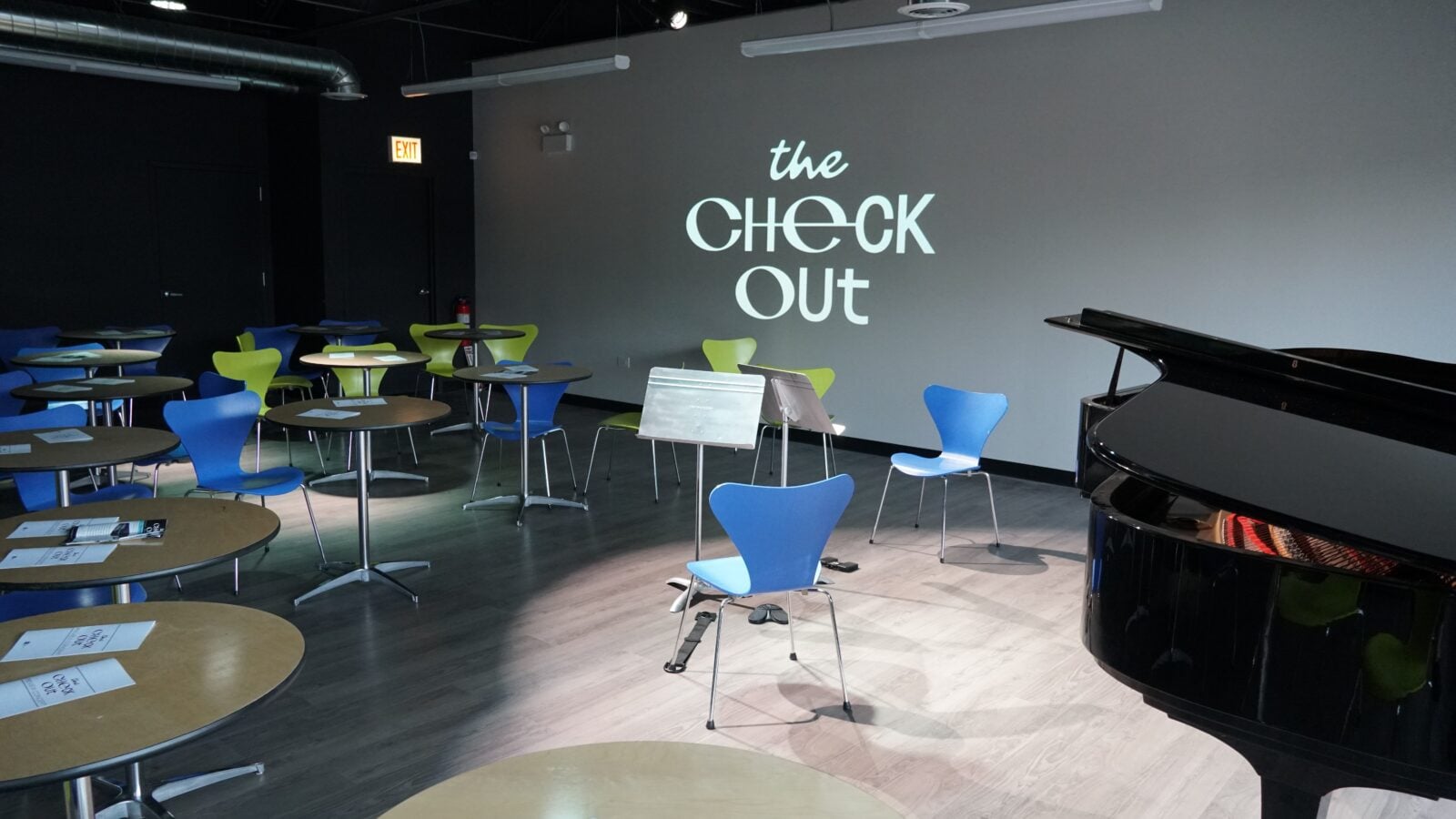
The Checkout, set up for a piano trio ahead of a media-only preview. (Photo: Alannah Spencer)
A refurbished, once abandoned 7-Eleven will soon be the site for Chicago’s newest classical music venue. And don’t worry – the slushies aren’t going anywhere.
The Checkout , located at 4116 N Clark St in Uptown, is the latest brainchild of composer, concert-producer, and arts manager Seth Boustead. The Executive Director of Access Contemporary Music, Boustead has been working in various capacities to bring classical music to non-traditional spaces for the past 20 years.
In light of the venue’s grand opening, and the 10th anniversary of ACM’s Thirsty Ears Festival, WFMT sat down with Boustead to discuss how creativity can fuel the fight for classical music visibility.
WFMT: What were some of the difficulties in transforming this former retail space into one that can host music while also catering to the needs of various groups?
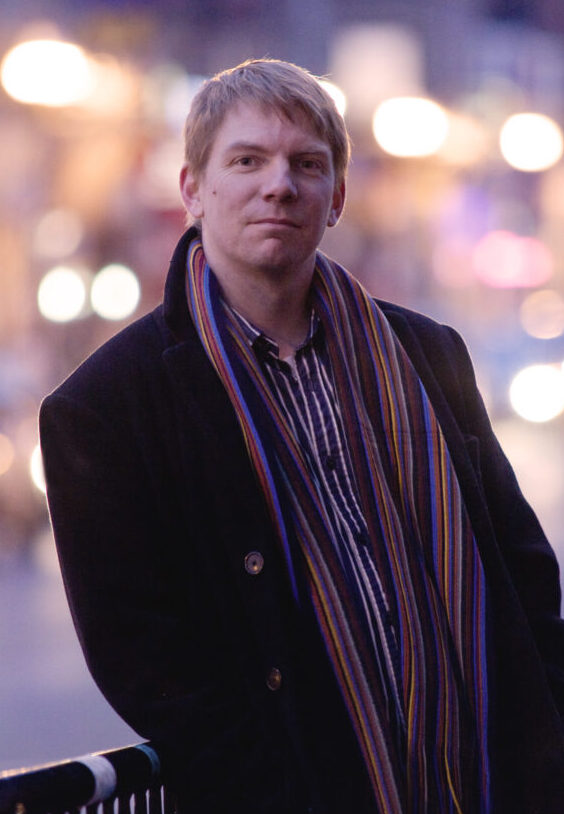
Seth Boustead (Photo: Provided by composer)
Boustead: Well, the biggest challenge is that everybody wants a slushie. Literally everybody asks me if there will be a slushie machine in the venue… and the answer is yes! It showed up yesterday in a wooden crate, like it was from Raiders of the Lost Ark or something. So it seems the slushie machine is gonna be this valuable object, the heart of the space.
But you know, this building had also been empty for 10 years. I used to buy my paper here when it was a White Hen and I bought my paper here when it was a 7-Eleven. One day it had a for rent sign on it, so I biked over and peeked in the window. Even though it was in a terrible, terrible state, I just could see it in my head – this is going to be an awesome place for chamber music.
The difficulties were getting the lease, then convincing the owner to rent to us in the first place…We had to get a zoning change, an architect, and an engineer. We had to raise at least $500,000 which we’re still in the process of doing. Then we had to get letters of community support from a ton of people. There was a lot to be done.
The construction is now finished, so we’re working on the fun stuff: acoustic treatment, lighting, decor, ambiance… I wanted to put a bar in, so we had to get a moratorium on alcohol sales lifted. The bar is partly for revenue, quite frankly, because the rent is high, but it’s also partly a way to encourage people to stick around. As a performer myself, I think you shouldn’t just go home after a concert: you should really chat about what you just heard with others.
And then, of course, everybody’s asking, what’s the piano gonna be? Forget the slushy machine: the piano is the real heart of the venue, right? I thought maybe we would borrow one from Pianoforte, so I contacted Thomas Zoells. But then he introduced me to a man who was shutting down a venue with an 8.5 ft Yamaha CS2 concert grand piano – just refurbished, beautiful instrument. He donated it to us. I will be forever grateful to Norman Cantor for that.
WFMT: How do you bridge that gap between novelty and classical music tradition in such an unusual space
Boustead: My whole career, I’ve put music in unusual places: as a pianist, as a programmer. When I had a radio show at WMT we did a lot of live broadcasts from weird places.
There’s a lot of flaws in non-traditional spaces. There’s somebody shaking a cocktail during the slow movement of the Schubert, you know, there’s ambulances, etc. But I’ve been fascinated over the years with putting classical music in unusual spaces in a way that’s respectful to the music, respectful to the performers, and respectful to the audience.
As we move into this AI-centric, meme driven, TikTok culture, I am concerned with people’s mental health as well. And I think that sitting for 60 minutes somewhere listening to music, without looking at your phone, is good for you. What we’re increasingly saying at ACM is that music is part of your health and wellness routine.
At The Checkout, you have some work as the audience. We’re going to ask you not to fiddle with your phone. We’re going to ask you to sit for 75 minutes and listen. If you find your mind wandering, that’s OK. You’re going to feel this very strong pull towards your phone the second you get bored; I know because I’m also a phone addict too. Resist it.
That’s partly the inspiration behind the name too. It used to be a 7-Eleven, which is one reason for calling it The Checkout, but we also want you to literally check out of your life and commune with people and live music in a way that’s meaningful
WFMT: It sounds like The Checkout also marks a slight shift in focus for ACM – or at least, an expansion of the initial vision.
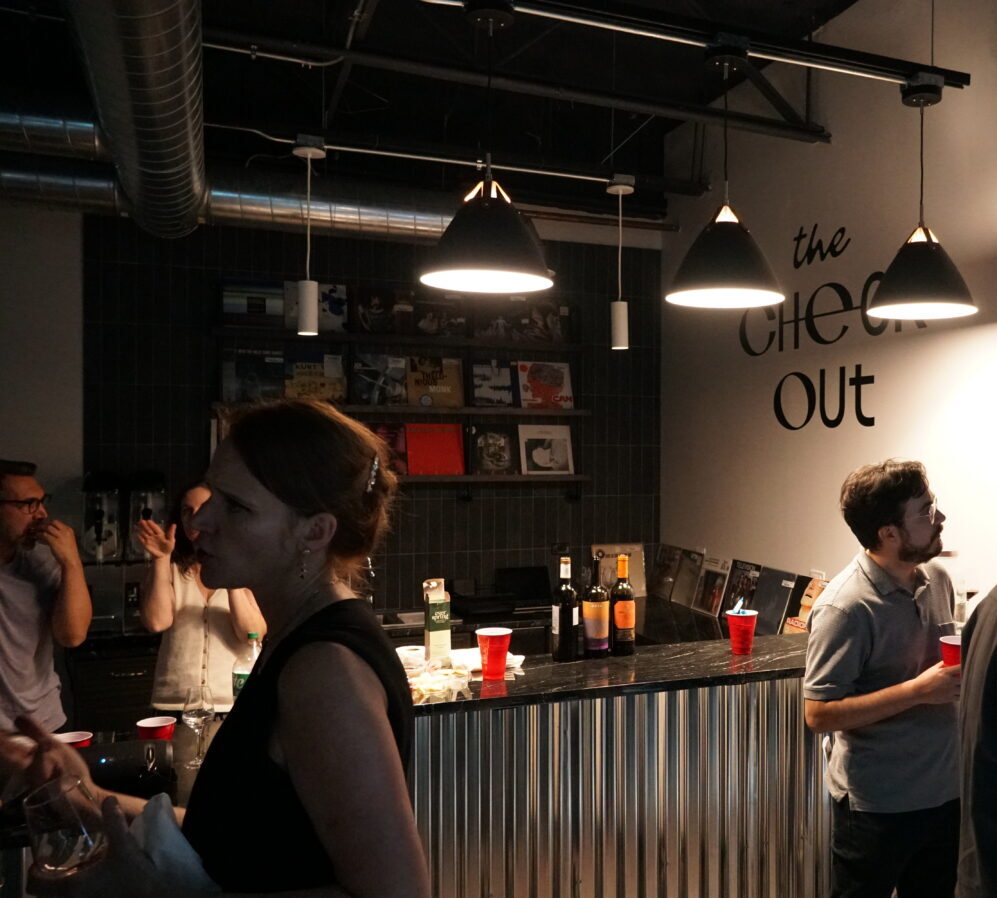
Bar and vinyl area in the Checkout (Photo: Alannah Spencer)
Boustead: Yeah – it’s become bigger, really, you know. For years, it was just about trying to put classical music in places where people could get to it. If you go to a concert, it’s kind of expensive, the people there seem to know more than you do, and you don’t even know when to clap… we just wanted to remove those barriers to entry.
We started with our Thirsty Ears festival – Chicago’s classical music street festival. Great example of a place where people come in who don’t think of themselves as classical music people. As people who deal in contemporary music, we want to show that this art form will continue. It can be the year 5000, and people will still be playing some form of the violin – I guarantee it.
The Checkout really ups the game for us. It’s the same things we’ve always been saying for years: remove the barriers for entry, make it accessible, but now adding this health and wellness component as well
WFMT: Speaking of Thirsty Ears, the festival is celebrating its 10th year. Looking back, what are you most proud of?
Boustead: When I started it, I was 43. Now I’m 53. I’m proud that I can still carry all the things we need to build the festival!
We build the stage ourselves, every tent, schlepping tent weights, cinderblocks, and audio gear… It’s also not easy to amplify classical music live on the street, so I’m very proud of my team. David Wetzel is our sound engineer and technical director. He is a magician. This year, we’re also gonna bring out our own piano, the gorgeous Yamaha that was donated to The Checkout.
We didn’t add another day for the anniversary, but we do have more ensembles than usual. I’m doing a set Sunday with a cello and viola. Chicago Sinfonietta is bringing out a brass quintet; Black Oak Ensemble‘s playing. There’s a new group in town called Nova Linea Musica: they’re doing a lot of big stuff, and they sponsored our stage. Violinist Rabia Brooke is going to do a set at Thirsty Ears.
Michael Miles is a banjo player I used to work with at the Old Town School of Folk Music, who has this American Bach project with a magnificent cellist. Michael Hall, the violist, is doing a set that’s gonna have a lot of heavy duty electronics and things in it. There’s a wide range of things.
It’s brilliant. And between The Checkout and the 10th anniversary of Thirsty Ears, I’m very gratified to see that the initiatives are getting this attention.
Right now it feels like I’m pinching myself a little bit. It’s a lot of work – two festivals within a couple of weeks of each other, which is insane. Not to mention we just celebrated the 20th anniversary of ACM as a whole last year. But there’s a lot on the horizon and a lot to be proud of.
WFMT: After Thirsty Ears, you are immediately preparing for The Checkout’s grand opening festivities, running September 13 through 28. What can people expect to hear
Boustead: We wanted to showcase the kinds of things that will be in the space going forward. We lean towards classical music because that’s our expertise, but there will also be cabaret and jazz: both art forms tangential to classical music. Jazz is often called American classical music. In cabaret, they’re singing Sondheim, Bernstein, and other people that cross over into our realm of classical.
Because ACM is one of the largest commissioners of chamber music in the country, the festival has a lot of commissions as well. We commissioned seven Chicago composers to write new music for the opening night concert – Celebrate Uptown – where the featured ensemble is the Amos Gillespie Quartet, with an interesting instrumentation of flute, clarinet, saxophone, and cello. Many of the composers drew on these photographs that I found from the 1970s by a man named Bob Rahak who really documented Uptown at that time.
Arvo Pärt turns 90 in September, so we’re doing two concerts because I know it’ll sell out. I really wanted to showcase his vocal writing and he has a piece called Sarah Was 90 Years Old about the biblical Sarah who gave birth when she was 90.
We’re working with Black Oak Ensemble on commissioned works inspired by Studs Terkel, since his book Working turned 50 last year. Kontras Quartet is doing a really sensitive and fascinating program. Pianist Matt Hagel is going to showcase our new piano. There’s just a ton of stuff: the festival’s action packed.
Then afterwards, we’ll settle into our regular programming.
The Checkout celebrates its grand opening with a 15 day festival from September 13 through 28. Tickets and more information can be found at thecheckout.org. ACM’s free classical music street festival, Thirsty Ears, celebrates its 10th anniversary August 23 and 24.