
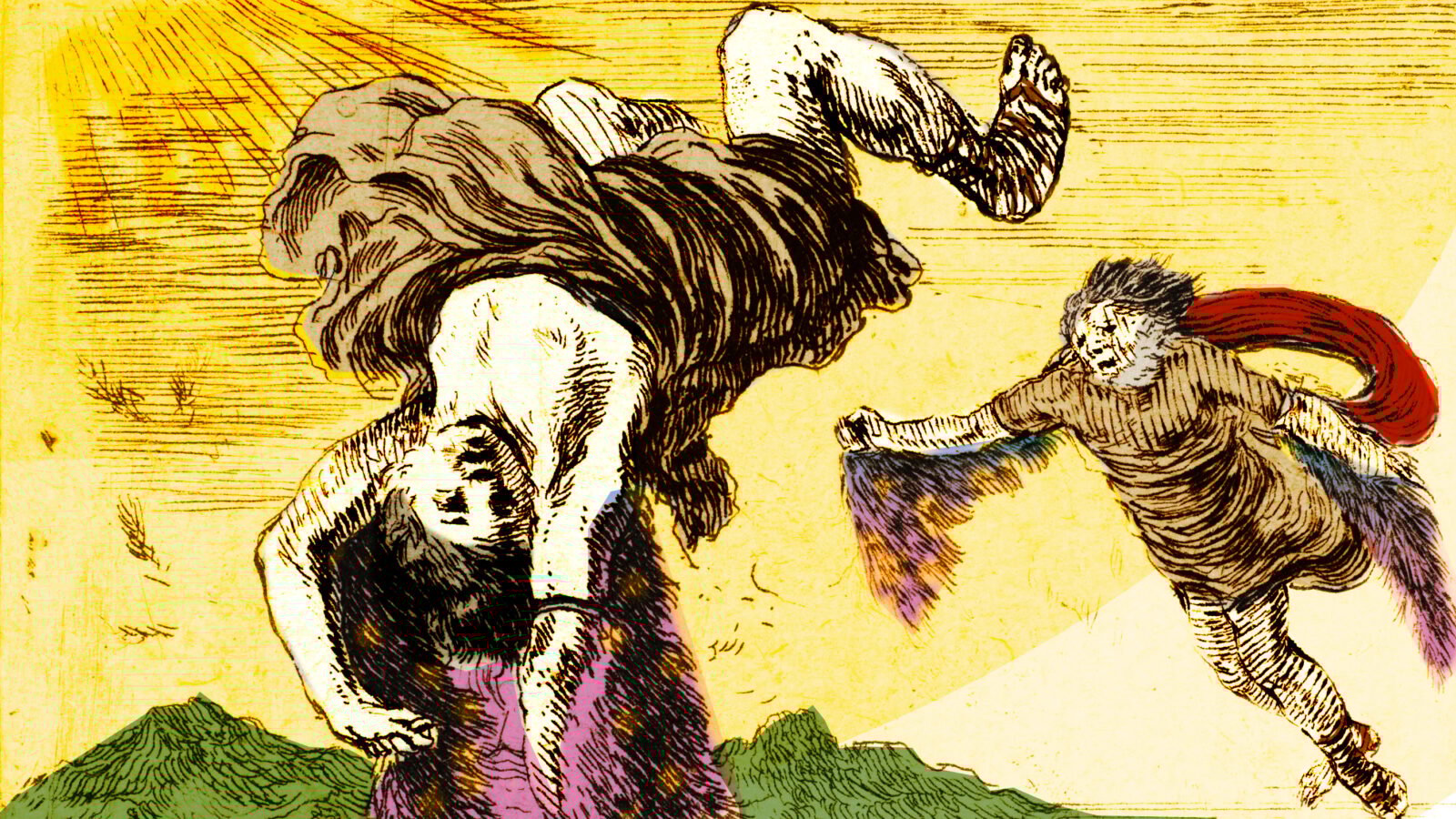
Daedalus and Icarus, from ‘Game of Mythology’ (Via Met Museum, color added by WFMT)
With mighty gods and goddesses, heroic mortals, and terrifying monsters, Greek mythology is replete with dramatic and musical potential. Composers have long looked to the Ancient Greeks for inspiration, whether forming the basis of opera plots or inspiring more abstract instrumental music. In this article, we will examine three famous myths and their musical interpretations, from one of the earliest operas to contemporary music by a Chicago composer.
Orpheus & Eurydice
One of the most commonly adapted Greek myths is the tragic tale of Orpheus and Eurydice. Orpheus, a poet and musician, has fallen in love with the beautiful Eurydice, but on their wedding night, she is killed by a venomous snake. Desperate to see his wife again, the grieving Orpheus travels to the underworld. Upon reaching the river Styx, he plays a song for Charon, the ferryman of the underworld, who is so moved that he agrees to take Orpheus across the water for free. On the other side, Orpheus encounters Cerberus, the three-headed dog. Once again, he uses his musical talents to lull the beast to sleep.
At the palace of Hades and Persephone, Orpheus recounts his sad tale and again sings them a song about his lost love. Hades takes pity on the widower and agrees to release the soul of Eurydice on one condition: Orpheus must not look back at Eurydice until they have left the underworld. Orpheus agrees and begins to lead his wife back to the land of the living. But just as they are almost out, Orpheus can no longer contain his excitement and glances back at Eurydice, causing her to be dragged back down into the underworld forever. The story is not only ripe for musical interpretation, with a musician as the protagonist, but it also serves as a parable about the virtue of patience and restraint in the face of temptation.
There are numerous operas that tell the tale of Orpheus and Eurydice, from Jacques Offenbach’s comic take in Orpheus in the Underworld to modern interpretations by composers like Matthew Aucoin and Harrison Birtwistle. But the use of the Orpheus myth in opera stretches back to the very beginnings of the genre. Claudio Monteverdi’s 1607 L’Orfeo was created when opera was still in its infancy, and it is still performed to this day.
But Monteverdi was not the first composer to adapt the Orpheus story! The first musical drama that scholars consider an opera was Jacopo Peri’s Dafne (1598). And in 1600, just two years later, Peri wrote an opera on the Orpheus story, demonstrating the myth’s prominent place within the culture.
That said, Monteverdi’s L’Orfeo is often considered the first “great” opera, and its composition changed the trajectory of music history forever. As we mentioned in our article on the evolution of the orchestra, Monteverdi was one of the first composers to denote the instruments he wanted in the score of L’Orfeo, setting the precedent for the configuration of the baroque orchestra. In addition, Monteverdi was exploring the boundaries of what this new genre of musical theater could be. In her book Music in the Baroque, Wendy Heller writes, “Like Orpheus, Monteverdi may well have regarded the opera as a test of music’s power. He uses nearly all the available styles of vocal music and a host of instrumental colors to dramatize the antithesis between Orpheus’s joy at his marriage to Eurydice and his sorrow at losing his beloved twice to the underworld.”
Another famous operatic interpretation of the Orpheus myth is Christoph Willibald Gluck’s Classical-era masterpiece, Orfeo ed Euridice (1762). Like Monteverdi’s L’Orfeo, Gluck’s setting of the Orpheus myth served as an inflection point in operatic history. Tired of the restrictive structures of opera seria, marked by lengthy da capo arias and secco recitative—as well as the vanity of singers who prioritized showing off their technique over dramatic integrity—Gluck set out to reform opera. With Orfeo, he wanted to make the genre more naturalistic, the characters deeper and less stereotypical, and the text just as important as the music. There is also a greater variety of musical structures, with shorter pieces linked together to form larger musical units. Da capo arias are also notably absent, as in the rondo-form aria “Che faro senza Euridice,” sung here by countertenor Aryeh Nussbaum Cohen, who will perform the role with Music of the Baroque in September.
Icarus
Minos, King of Crete, tasks architect and inventor Daedalus with constructing a labyrinth so complex that no one can escape. However, when Theseus manages to get out by following a string Ariadne had given him, Minos is furious, imprisoning Daedalus and his son, Icarus, deep within the maze. Even though he had designed it himself, Daedalus cannot find his way out. Realizing the only way out is up, he constructs two pairs of wings made of feathers and wax for him and his son.
As they escape, Daedalus warns his teenage son not to fly too high because the wings are delicate and could break. Despite his father’s warnings, Icarus, exhilarated by the feeling of freedom, starts to climb higher and higher. Eventually, he soars too high, and the heat of the sun melts the wax. Feathers fall out one by one, and Icarus eventually plummets into the ocean. Giving rise to the idiom “flying too close to the sun,” the myth warns of the dangers of overconfidence.
When composer Lera Auerbach was growing up in Chelyabinsk, a city on the border of Siberia, she immersed herself in the realm of Greek mythology to help her make sense of the world around her. In 2011, she extracted the last two movements from her Symphony No. 1, “Chimera,” (2006) to create the symphonic poem Icarus. Although the myth of Icarus was not in her mind when she initially composed the work, she was reminded of the myth after hearing the extracted movements in their new context. “All my music is abstract, but by giving evocative titles I invite the listener to feel free to imagine, to access his own memories, associations,” she writes in her program note for Icarus. Further, the title beckons the listener to reflect on the innate human desire to transcend the limits imposed on us.
Christopher Tin calls his work Daedalus and Icarus a “mini-opera.” Lasting just under six minutes, it packs a dramatic punch, with Latin text sung by a tenor soloist, accompanied by an opera chorus and full orchestra. It comes as the second movement of Tin’s oratorio To Shiver the Sky. Composed between 2016 and 2019, the oratorio covers the history of flight and humanity’s yearning to take to the skies. As he writes in the program note, “Told through the words of 11 of our greatest astronomers, inventors, visionaries and pilots, it charts our relentless need to explore the universe, defy our earthly bonds, reach for the face of God, and ultimately claim our place among the stars.” Instead of taking the Icarus myth as a cautionary tale about hubris, Tin considers Icarus’s flying too close to the sun to be a metaphor for attaining forbidden knowledge.
Medusa
Medusa is one of three daughters of the sea gods Phorcys and Ceto. All three sisters are renowned for their beauty, but Medusa—the only mortal—is the fairest of them all, causing any man who sets eyes on her to fall immediately in love. Nevertheless, she decides to take a vow of celibacy and become a priestess of Athena, the goddess of war and wisdom. One day, while taking a walk by the sea, Poseidon sees Medusa and falls in love. He follows her back to Athena’s temple and forces himself on her. Furious at what has occurred in her sacred space but unable to direct her anger at her powerful uncle, Poseidon, Athena blames Medusa for allowing herself to be defiled and breaking her vow of celibacy. She curses Medusa, transforming her long hair into a tangle of snakes and making it so her eyes turn anyone who looks upon them into stone. Medusa’s sisters are similarly disfigured as punishment, and the three of them are banished to a cave.
Warriors come to hunt the sisters for sport, but they are no match for the sisters, now called the Gorgons, who end up killing anyone who comes near. Eventually, Perseus, armed with an indestructible sword, winged sandals, and a reflective shield, manages to cut off Medusa’s head, using the reflection from the shield to avoid looking at her. From Medusa’s headless body springs the winged horse Pegasus, Poseidon’s child, which had been growing inside her. Perseus rides Pegasus home and uses Medusa’s severed head to defeat his enemies. The story of Medusa is perhaps not a moralistic one, but it does show how victim-blaming is a tale as old as time.
20th century Austrian composer Gottfried von Einem is best known as a composer of dramatic works, producing a number of successful operas and ballets. He is also credited with helping revitalize Austrian music after World War II. In 1957, he wrote Medusa, Op. 24, a ballet in three scenes, which he later extracted into a concert suite. In the ballet scenario, Medusa longs for the love of a man, but cannot control her effect on those who look at her. In the second scene, a sailor blinded by saltwater washes ashore. Because of his blindness, he cannot be turned into stone, but when they embrace, he feels her hair of snakes and realizes he has fallen into Medusa’s arms. He flees, and Medusa is again dejected. In the final scene, she pleads with Perseus, still longing for the touch of a man, when he cruelly beheads her.
“Becoming Medusa” is the first movement of Stacy Garrop’s Mythology Symphony. Written in 2007, “Becoming Medusa” began as a commission for the Detroit Symphony. Subsequent commissions resulted in the rest of the workf which premiered in full in 2015. The Chicago-based composer writes in her program note that she chose to tell Medusa’s lesser-known backstory as a beautiful priestess before she was transformed into the Gorgon monster.
“Musically, Medusa is represented by a solo violin,” Garrop explains. “When she first appears as a lovely woman (following a dissonant introduction indicating her final state), she is accompanied by harp, and her music is very lyrical. After Medusa is transformed, dissonance surrounds her: strings, woodwinds, and percussion represent the snakes on her head as they twist and turn around each other, while her piercing eyes are depicted by the discordant interval of a minor second. In between, we hear her sultry seduction of Poseidon and Athena’s furious reaction.”
The scope of Greek mythology—and its musical interpretations—is so vast that we could only cover a fragment in this article. However, we hope you have gained an appreciation of how the ancients have inspired composers across music history and continue to speak to us today.


