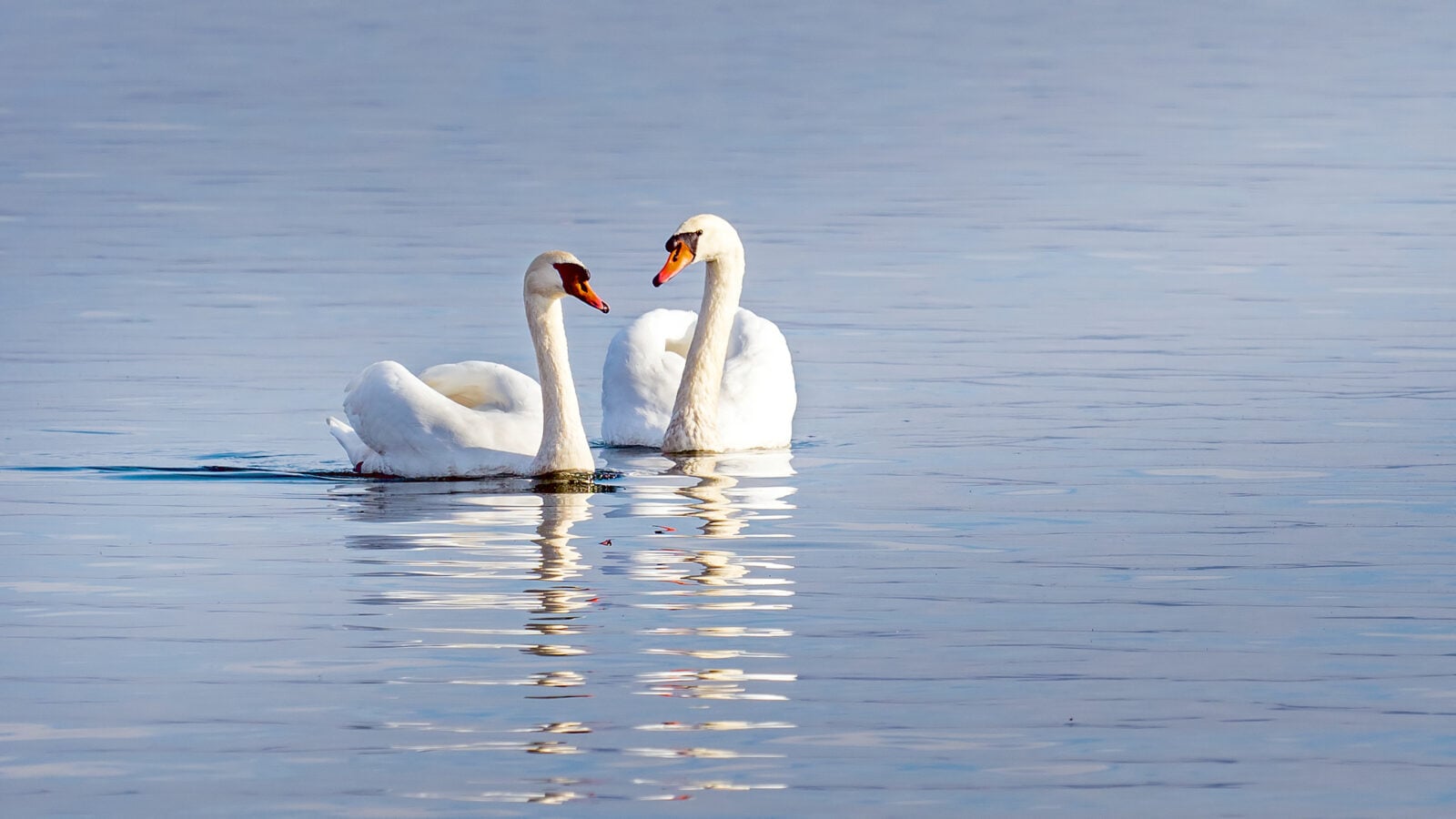
 Tchaikovsky’s ballet Swan Lake and “The Swan” from Saint-Saëns’ Carnival of the Animals are two beloved works that both happen to be inspired by the strikingly graceful waterfowl. But did you know there’s actually quite a lot of other music inspired by swans? The birds feature in Greek and Finnish mythology as well as Aesop’s fables, symbolizing grace, beauty, love, and majesty. With this wealth of allegorical associations, these elegant creatures have captured composers’ imaginations for centuries.
Jean Sibelius: Symphony No. 5 and “The Swan of Tuonela”
Finnish composer Jean Sibelius (1865–1957) was moved to depict swans in music in multiple compositions. First, there is the sweeping “Swan Hymn” in the final movement of his Symphony No. 5. This melody was inspired by an awe-inspiring experience Sibelius had one April day in 1915: “Today at ten to eleven I saw sixteen swans,” he wrote in his diary. “One of my greatest experiences! Lord God, what beauty! They circled over me for a long time. Disappeared into the solar haze like a gleaming silver ribbon.” He captures this moment in the final movement in what is colloquially called the “Swan Hymn.” This section features a swinging horn motif that evokes the graceful beating of the swans’ wings, while the cellos and woodwinds’ countermelody suggests their call.
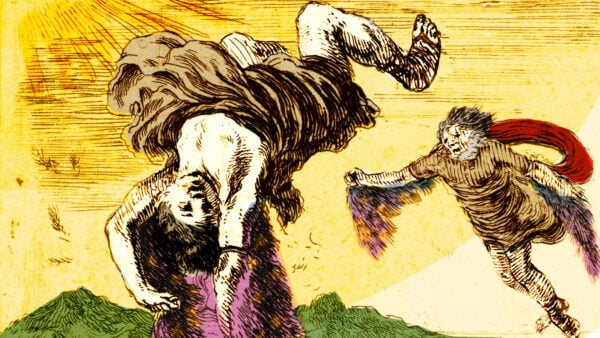
In the Kaleva, a collection of epic poetry from Karelian and Finnish oral folklore and mythology, swans play a more sinister role. According to myth, a swan guards Tuonela, the land of the dead. Akin to a Finnish Hades, Tuonela is surrounded by a dark, wild river. In the story, the heroic adventurer Lemminkäinen has come to kill the swan in an effort to woo the daughter of a sorceress. In his attempt, he is mortally wounded and falls into the river of death. Sibelius captures the serene but foreboding atmosphere of Tuonela in Tuonelan Joutsen (“The Swan of Tuonela”). The music is so slow as to be almost static, evoking the incantatory repetitiveness of the runic singing traditionally used to transmit the Kalevala poetry and the stillness of the foreboding waters. Again, turning to the woodwinds, Sibelius employs a melancholy English horn to evoke the voice of the swan.
Orlando Gibbons: “The Silver Swan”
“The silver swan, who living had no note,
When death approached unlocked her silent throat.
Leaning her breast against the reedy shore,
Thus sang her first and last and sung no more:
‘Farewell all joys, O death come close mine eyes,
More geese than swans now live, more fools than wise.’” – Anon.
“The Silver Swan” by Orlando Gibbons (1583–1625) is a popular English madrigal. It begins his First Set of Madrigals and Motets of 5 Parts, which was published in 1612 with the support of Gibbons’s patron, Christopher Hatton. Although we do not know for sure who wrote the song’s text, some have posited (with no evidence) that it was Gibbons’s own handiwork, while others believe Hatton may have had a hand in selecting the texts for the whole volume.
Regardless, the short poem is beautiful in its simplicity. It tells of the ancient belief that swans sing a beautiful song just before their death, having been silent much of their life, or their sounds heretofore unmusical. The origin of this belief—while ornithologically inaccurate—is up for debate, but it appears in Greek mythology, Aesop’s fable “The Swan and the Goose,” and the works of Plato, Socrates, and Ovid. It is from this myth that we get the term “swan song,” meaning one’s last hurrah before retirement or death.
Gibbons’s composition is one of the most enduring English madrigals, its simple contrapuntal writing and subtle text painting perfectly matching the directness of the text. It has since inspired numerous arrangements and original settings of the poem, including by Ned Rorem and Lori Laitman.
Carl Orff: “Olim lacus colueram” from Carmina Burana
Carl Orff captures the swan in a much different light in his secular cantata Carmina Burana (1937). Orff drew the text for his cantata from the Carmina Burana codex, a collection of secular poems in Latin, High Middle German, and Old Provençal dating from the 11th to 13th centuries. These texts were primarily written by goliards, itinerant student clerics who penned satirical, often bawdy poetry to vent their frustrations at the Church and the clergy in positions of power.
The 12th movement, “Olim lacus colueram,” depicts a swan roasting on a spit, told from the perspective of the unfortunate bird. In this most literal of swan songs, he sings, “Once I lived on lakes. Once I was beautiful when I was a swan. Miserable me! Now black and roasting fiercely.”
First, the jaunty bassoon and muted trombone introduction effectively capture the honking of the distressed bird. Then, the swan’s lament is set extremely high in the tenor soloist’s range, giving the solo an intentionally strained quality. Sometimes the movement is sung by a countertenor instead, making it less pained but more haunting and otherworldly.
Maurice Ravel: “Le cygne” from Histoires Naturelles
In 1906, Maurice Ravel (1875–1937) composed Histoires Naturelles (“Natural Histories”), a song cycle for voice and piano that sets five poems by Jules Renard. Each poem presents a character study of a different animal, from the peacock and cricket to the kingfisher and guineafowl. The central song in the cycle is “Le cygne,” or “The Swan.” The poem tells of a swan who is fishing for the clouds reflected in the pond. Each time the swan plunges his beak into the water, he comes up empty as the ripples disperse the cloud. Yet, the end of the poem reads, “He exhausts himself fishing for empty reflections and perhaps he will die, a victim of that illusion, before catching a single shred of cloud. But what am I saying? Each time he dives, he burrows with his beak in the nourishing mud and brings up a worm. He’s getting as fat as a goose” (trans. Richard Stokes).
Ravel musically depicts the rippling of the pond with soft piano arpeggios and rolled chords and the calm movement of the swan with the legato vocal line—that is, until the swan plunges its head into the water, captured by a descending octave leap. When the swan comes up empty, the piano accompaniment disappears into staccato punctuations.
Camille Saint-Saëns: The Swan
Of course, we cannot neglect the most famous representation of a swan in music—“The Swan” from Camille Saint-Saëns’s The Carnival of the Animals (1886). Little did Saint-Saëns know that
this humorous suite that he wrote as a bit of fun—a distraction from a concert tour gone wrong—would become his most popular work. Given the lighthearted and accessible nature of the piece, he forbade public performances and publication of the work during his lifetime to avoid detracting from the “serious” composer image he was trying to cultivate. In 1922, the year after Saint-Saëns’s death, Durand published the whole suite, and it became an instant classic.
The only part of the suite Saint-Saëns allowed to be published during his lifetime was an arrangement of the penultimate movement, “The Swan,” for solo piano and cello in 1887. Like Ravel, Saint-Saëns paints the placid lake with soft piano arpeggios, while the lyrical cello captures the bird’s graceful swimming. The sweeping melody—one of the most romantic in all of classical music captures the swan’s association with romance, as these birds purportedly mate for life.
Pyotr Ilyich Tchaikovsky: Swan Lake
Finally, a brief word on Tchaikovsky’s beloved ballet Swan Lake, one of the most performed ballets in the canon. Despite its popularity today, it was not an immediate hit when it premiered at the Bolshoi Theater in Moscow in 1877. Tchaikovsky’s score was revolutionary, redefining and elevating music’s role within classical ballet. But the dancers complained it was too rhythmically complex to dance to and too long. Nonetheless, the ballet’s romantic story and lush, melodically memorable score eventually solidified it in the canon. Today, it is most often performed in an edited version created after Tchaikovsky’s death, which shortens it significantly (though the Mariinsky Ballet performs a version dating to the 1950s that has a happy ending).
No one quite knows where the story for Swan Lake came from. Some propose that it stems from German or Russian folklore. Others argue it was the creation of the original choreographer, Julius Reisinger, or the director of the Moscow Imperial Theaters, Vladimir Petrovich Begichev. Regardless, it is a heartbreakingly beautiful story, which again taps into swans’ romantic connotations.
In the ballet, Prince Siegfried encounters a group of swans while hunting. One of the swans transforms into a beautiful maiden named Odette. She explains that they were turned into swans by the evil Baron von Rothbart, only returning to their human form by night. The only way to break the spell is if someone who has never loved before swears to love her forever. Siegfried declares his love for Odette and promises to be loyal to her.
At a palace ball the next evening, Siegfried must pick a bride. He sees a woman whom he takes to be Odette and asks her to marry him. However, it is not Odette but Odile, Rothbart’s conniving daughter in disguise. When Siegfried realizes his mistake, it is too late. He follows Odette to the lake and asks for her forgiveness. She forgives him, but the deed is done—he has broken his vow. They decide to drown themselves in the lake so they can stay together forever in death.