The first Canadian to win the Concours musical international de Montréal releases his second solo album for Naxos, featuring works by Scriabin and Rachmaninoff. Simon-Pierre Bestion imagines the funeral music of the last Carolingian emperor by compiling chants and hymns from the medieval world. Clarinetist Chen Halevi and the Arethusa Quartet juxtapose two colorful, contemporary chamber works by Osvaldo Golijov and Pēteris Vasks. Finally, two engaging female composers from the 20th century get their flowers with albums dedicated to some of their best work.
New Releases May 5: Jaeden Izik-Dzurko, Arethusa Quartet, and more

Pianist Jaeden Izik-Dzurko

Pianist Jaeden Izik-Dzurko made history as the first Canadian to win the Grand Prize at the Concours musical international de Montréal in 2024, the same year he was named Gold Medalist at the 2024 Leeds International Piano Competition. His second solo album for Naxos is a souvenir of his recital from the 20th Paloma O’Shea Santander International Piano Competition (2022), where he was awarded First Prize and the Audience Prize. In his program, Izik-Dzurko explores the evolution of Scriabin’s musical language, showcasing his transition from youthful lyricism to the bold harmonies found in the Piano Sonata No. 5. This progression reveals the composer’s increasing intensity and imagination. Complementing this is Rachmaninoff’s Piano Sonata No. 1 in D minor, which highlights Izik-Dzurko’s majestic control and poetic sensitivity, solidifying his reputation as one of today’s most exciting and accomplished young artists

In 1558, two years after the last Carolingian emperor Charles V had stepped down from power, he realized his death was near and decided to have a rehearsal for his own funeral. This scene provides the starting point for Simon-Pierre Bestion’s imaginative assemblage of chants and hymns demonstrating Arabic influence in Spain, Requiem mass movements, and much more with his ensemble La Tempête. Bestion explains: “This is … not a historical reconstruction of Charles V’s funeral, but rather a poetic and non-exhaustive testimony to a Spain that lay at the crossroads of two worlds: the medieval world, which symbolically came to an end with La Reconquista … and the world of the Renaissance, symbolized by the simultaneous discovery of the New World. I have drawn on the liturgical structure of the Requiem Mass to create a kind of spiritual and emotional immersion in a musical environment to mark the death of the greatest monarch of the Renaissance.” The final work on the album, Parce mihi, Domine by Cristobal de Morales, concludes Bestion’s imaginary funeral as the only part of the program known definitively to have been performed on the actual occasion.
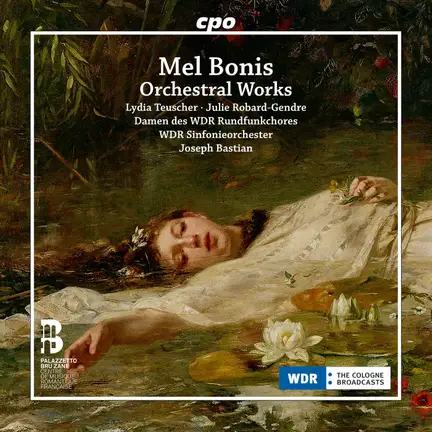
Mel Bonis (1858-1937) was a great musical talent and a sensitive soul, the child of a socially aspiring family who forbid their daughter to marry the love of her life. Forced into a utilitarian marriage with a respectable husband, she later had an affair with her first sweetheart after all — the stuff of a sentimental novel. Yet she was no fictional character, but rather one of France’s most prolific late-Romantic composers. Celebrated for her piano works, chamber music, and art song, Bonis also enriched the repertoire of impressionism with numerous original gems and arrangements for orchestra. Her particularly modern symphonic poem Ophélie, her Spanish waltz Les Gitanos, and her dances for orchestra are just some of the enchanting discoveries recorded here by the WDR Symphony Orchestra conducted by Joseph Bastian. Soprano Lydia Teuscher sings Le chat sur le toit, a purring melody of an enamored tomcat on a roof at night; mezzo-soprano is the soloist for Noël de la Vierge Marie; and the women of the WDR Radio Chorus join the orchestra for Le Ruisseau.

German composer Johanna Senfter (1879–1961) was a student of Max Reger, who recognized her musical talent and encouraged her to pursue advanced studies in his composition class in Leipzig, which she completed with distinction in 1909. In 1910, she was awarded the Arthur Nikisch Prize for best student composition of the year. Born into a well-to-do industrial family, she was financially independent and able to devote herself entirely to her creative work throughout her life. In addition to numerous chamber works, Senfter left behind nine symphonies. From the youthful ‘̛Sturm und Drang’ of her first symphony (1914) to the thoughtfully moving ninth (1949), composed after two world wars, the development of her musical language can be discovered here with these world premiere recordings by the Rheinland-Pfalz State Philharmonic under the direction of Chelsea Gallo .
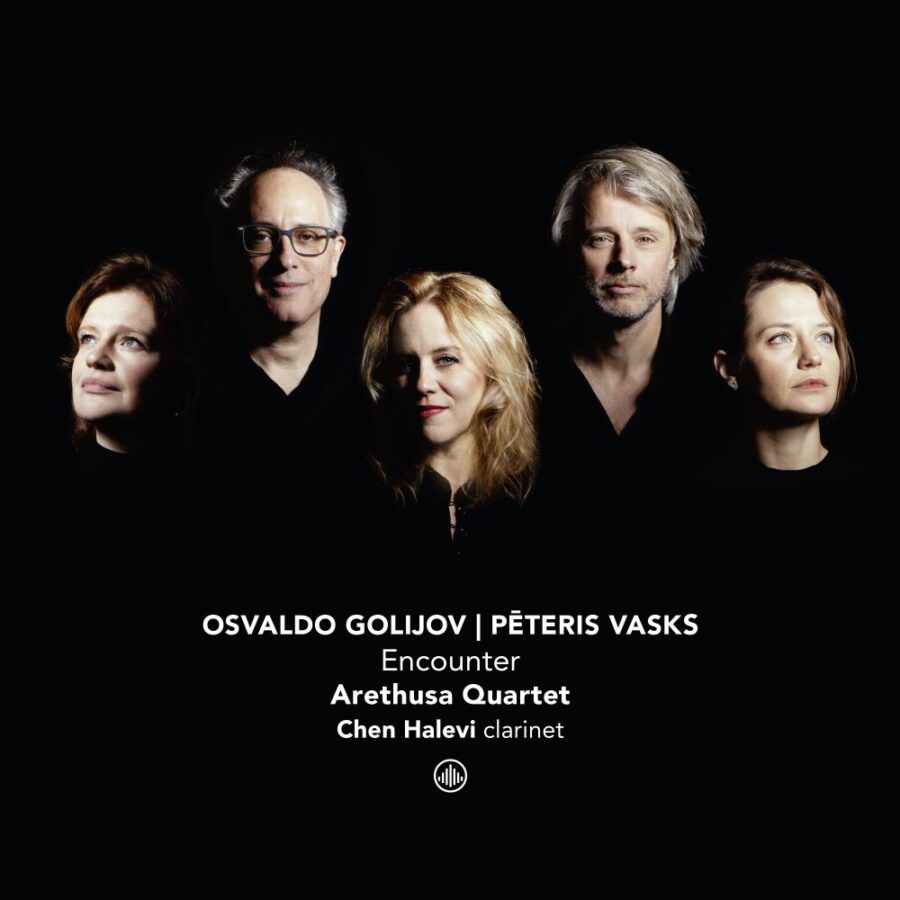
Clarinetist Chen Halevi and the Arethusa Quartet bring together two towering works of contemporary chamber music from profoundly different traditions: Osvaldo Golijov’s The Dreams and Prayers of Isaac the Blind and Pēteris Vasks’ String Quartet No. 6. Golijov’s ecstatic, ritual-like score finds the composer returning to Jewish mysticism, while Vasks’ Sixth Quartet references Baltic spirituality, tracing a life’s arc from farewell and remembrance to a final, hushed encounter with transcendence. Both works are intensely personal, rooted in lived experience and belief, and animated by music’s power to give voice to what lies beyond words.