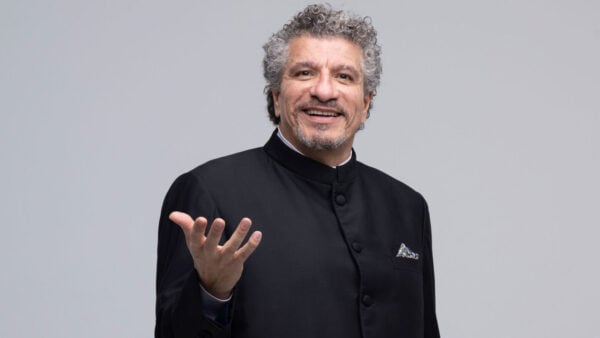
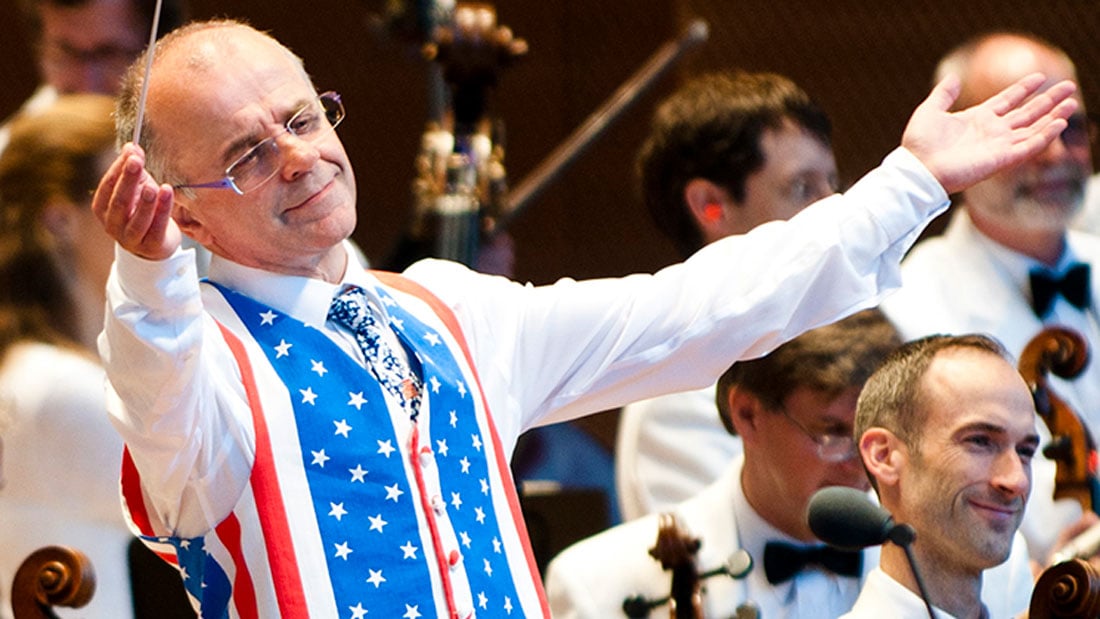
Christopher Bell conducting the Independence Day Salute
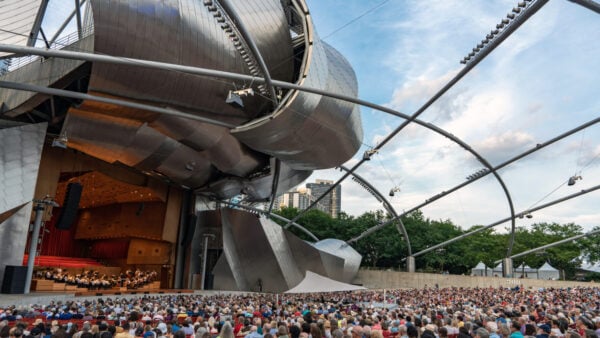
It simply isn’t a Chicago summer until you see Christopher Bell sporting his traditional red, white, and blue at the Pritzker Pavilion. As he walks onto the stage with a smile as bright as his clothes, the conductor is a physical reminder of the magic that Grant Park Music Festival has been bringing Chicagoans since 1935.
While Bell can’t say he was present at the first festival, he has become one of Grant Park’s long-standing artistic partners, celebrating 25 years of Grant Park leadership this season. An Irishman, Bell harbors an enthusiasm for the annual 4th of July Salute that is unmatched, and his dedication to his craft has endeared him to fans of choral music across the city.
WFMT sat down with the ambitious choir director to discuss his legacy, the evolution of Chicago’s choral sound, and his thoughts on American music as his own anniversary coincides with the 250th anniversary of the United States.
WFMT: How did you first get involved with the Grant Park Music Festival?
Christopher Bell: Almost 30 years ago, then principal guest conductor at Grant Park (James Paul) came to Scotland where I lived and worked. The company he was working with hired the Royal Scottish National Orchestra Chorus to record a piece called the Joan of Arc Mass, and we spent quite a lot of time learning it. As a result, we really knew it well and delivered a great result.
When James came back to Grant Park, he suggested me to Jim Palermo, then Artistic and General Director, for the role of Grant Park’s choral director. So they got in touch and asked, could I come in 1999 and prepare Mahler II for the audition.
I said no, because I was touring Australia with the RSNO, and there was no time. I remember thinking it was a shame – I’ll never be asked again. But they came back with another invitation: to come the following year and prepare Bartok’s Cantata Profana and Kodály’s Psalmus Hungaricus.
As it happens, we had visa issues and I missed the first two rehearsals. When I arrived the following week, the chorus was grumpy: they were having to do hard music on far too short a rehearsal time. But I just tore in, said hello, and away we went. I worked and worked and worked…and the concert went reasonably well!
After I became one of the two finalists, I prepared Verdi’s Requiem and a Haydn Mass. Then, they offered me the job!
WMFT: How has this position with Grant Park influenced your development as a conductor and musician?
Bell: Well, Chicago singing is quite unique. The basic foundation is driven by people studying at Roosevelt, DePaul, and Northwestern, thinking about an operatic career. There’s Bel Canto singing; there’s big, dramatic voices. It goes back to Margaret Hillis and the Chicago Symphony Chorus, and reflected in the way Margaret Hillis’s protégé , Thomas Peck, formed Grant Park.
What I heard when I first met the Grant Park Chorus was definitely that Chicago sound. I’ve added to it over the years by training and choosing the right sort of voices. I’ve added a very wide flexibility so that we can do that big, full-on operatic sound, but also go through the various colors to a more classical, Haydn/Mozart kind of a sound: as clean as a church choir, but still able to turn on a dime and do Broadway.
Now, how has this influenced me? It’s shown me what the voice is capable of…I’ve gotten used to the more operatic sound over here, and have taken that back to the UK. I’ll be working with choruses including the Edinburgh International Festival Chorus and can ask for more of an operatic sound, whereas over here, I’m asking them to be more versatile.
It’s been wonderful over the years and we’ve done such an extraordinary amount of repertoire.
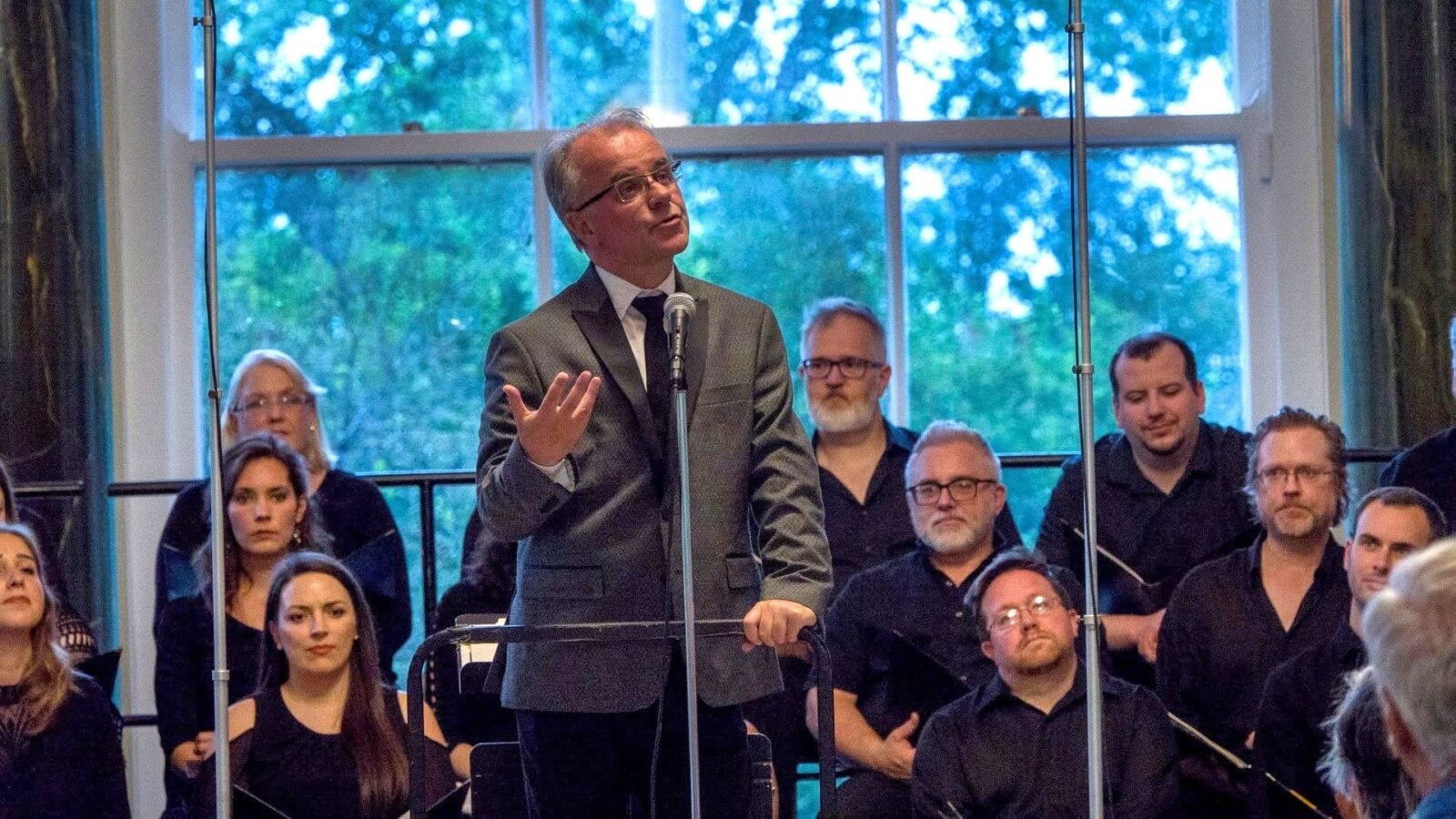
Christopher Bell with the Grant Park Chorus at the South Side Cultural Center. (Photo: Charles Osgood Photography)
WFMT: Speaking of big repertoire, two upcoming choral concerts center American music as part of the nation’s 250th celebration. What criteria did you use to help you narrow down your selections?
Bell: The American Choral Classics concerts are built in conjunction with the general manager Chris Collins. When Chris and I started talking about this program, the idea was to perhaps try and define what the United States of America might stand for, might believe. Maybe particularly for people outside America looking in, there’s also a historical question of what might America be?
Of course in 2026, there could be some opposing views to the way America should be going. In a way, we’ve reflected that in the program. It might be the land of the free; it might be the land of opportunity, where with enthusiasm and hard work you can succeed. American values are so centered around the ability to build a life for yourself and your family, so we’ve got some traditional music here: Shenandoah, When the Saints Go Marching In, even The Road Home, which is a more contemporary song about a sense of homeland.
But America’s history, like a lot of places in the world, has troubled elements to it. We’ve got songs like Black is the color of my true love’s hair. And then, there’s a very provocative piece: Melissa Dunphy’s What do you think I fought for at Omaha Beach
Within this piece, the text is the testimony of Philip Spooner at a hearing to discuss the Marriage Equality Bill on April 22, 2009. He basically says: “I have been a lifelong Republican…and I was born to believe that all men are created equal. I served in the U.S. Army. I’ve seen so much suffering. And I’m here today because of a conversation I had when I was voting, where a woman asked me, do you believe in equality for gay and lesbian people?” He continues, “It makes no sense to me. What do you think I fought for at Omaha Beach? I fought for freedom. These are the values that make America. My wife and I did not raise four sons with the idea that our gay son would be left out.” You get the message.
There are fundamental values that perhaps 1,000 Americans would agree on, but lots of things that they wouldn’t. This program perhaps sums up the kind of state we’re in. There’s something about our traditional values, and there’s something about the questions we need to ask surrounding them.
WFMT: Is there even such a thing as an “American” choral sound, right now or historically?
Bell: Interestingly, I’ve never been asked this question. My first thought is yes. Music across the world is affected by the language that you’re singing in. When we think of French, we think of the softness of the French language. You think about the character of the German language. You think about the dark sounds in the Russian language, and how that affects the sound. And then obviously you think about an American accent.
Now, of course, you’ve only got to travel in America a few hours to hear something different. Over the 25 years I’ve been here, I’ve been so blessed to have a little bit of time off and zoot around the place. I’ve been to California, New Orleans, Boston, New York, Seattle – you name it. All these places, and not one singular American accent.
We always make sure to respect and understand the languages. But I don’t know if there’s a comparison with English. I giggle sometimes, particularly when the chorus here sings a British piece in an American accent. It goes very well until you get to one word. There was a word last year that was S H O N E. In the UK we would pronounce that as “shon” (Sean). As in “the sun Sean.” But they were pronouncing the long “oh”, as the sun shone… and I was completely baffled. But everybody did it. And I thought, we’re singing to your people, so I’m not going to change it.
Another aspect: a lot of choirs, even volunteer choirs, sing with a more trained sound in the States. We are hearing a lot more spin, a lot more vibrato in the sound. So is there a particular American sound? Yes – perhaps informed by trained sound and by the color of the American English language. But in the 25 years that I’ve been here, I’m noticing a lot more versatility among ensembles recently that is broadening that sound.
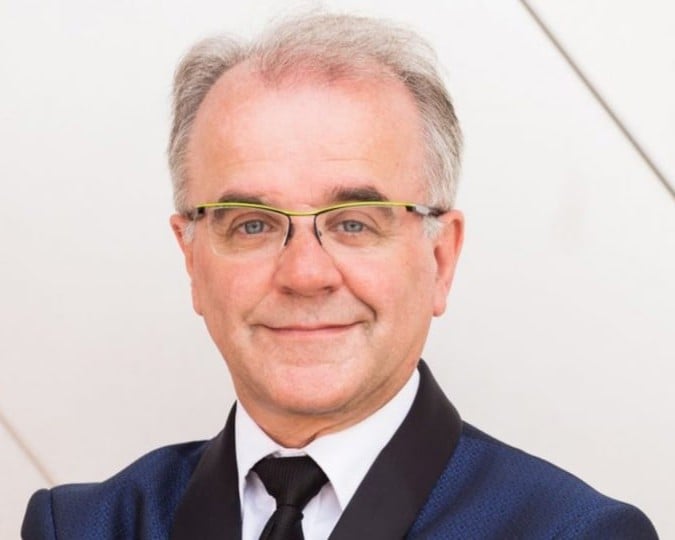
Christopher Bell.
WFMT: What’s running through your head as you’re entering your 25th season with the Grant Park Music Festival?
Bell: The one thing that’s different for me this year is a concert with the chorus and orchestra titled Christopher’s 25th Anniversary. There are two British pieces: one English, and one Scottish piece. I’ve always enjoyed the music of Vaughan Williams. James MacMillan is one of the leading contemporary composers in the world, and happens to be somebody with whom I sang in a barbershop group. I was at the premiere of his piece that we’re performing, Cantos Sagrados. Because of the anguish in that piece, we wanted to balance it out with the balm of a requiem. And Faure’s Requiem is definitely one of my favorite pieces.
For me, this season offers an opportunity to show off the chorus I’ve been working with for so long. I wrote down a couple of words while thinking about talking to you, contemplating the job of a chorus director, and what I have been intending to do. My first concern coming into this job was not to make things worse. If an organization has a reputation, you’d like at least to maintain that. So that was my first goal – maintain. The longer you’re here, the more you also need to monitor the health of the voices and keep the instrument, the choir, working as it should.
Then there’s the next goal – strategic. What voices should I bring in to maintain the sound, to enhance the sound, as people leave the choir? The final thing is to build – build and enhance. To maintain; to build; to be strategic, and to enhance – that’s what we’ve been doing. And for my 25th anniversary concert, what I hope to show is a chorus that’s capable, versatile, exciting, and one of the jewels in Chicago’s musical crown.