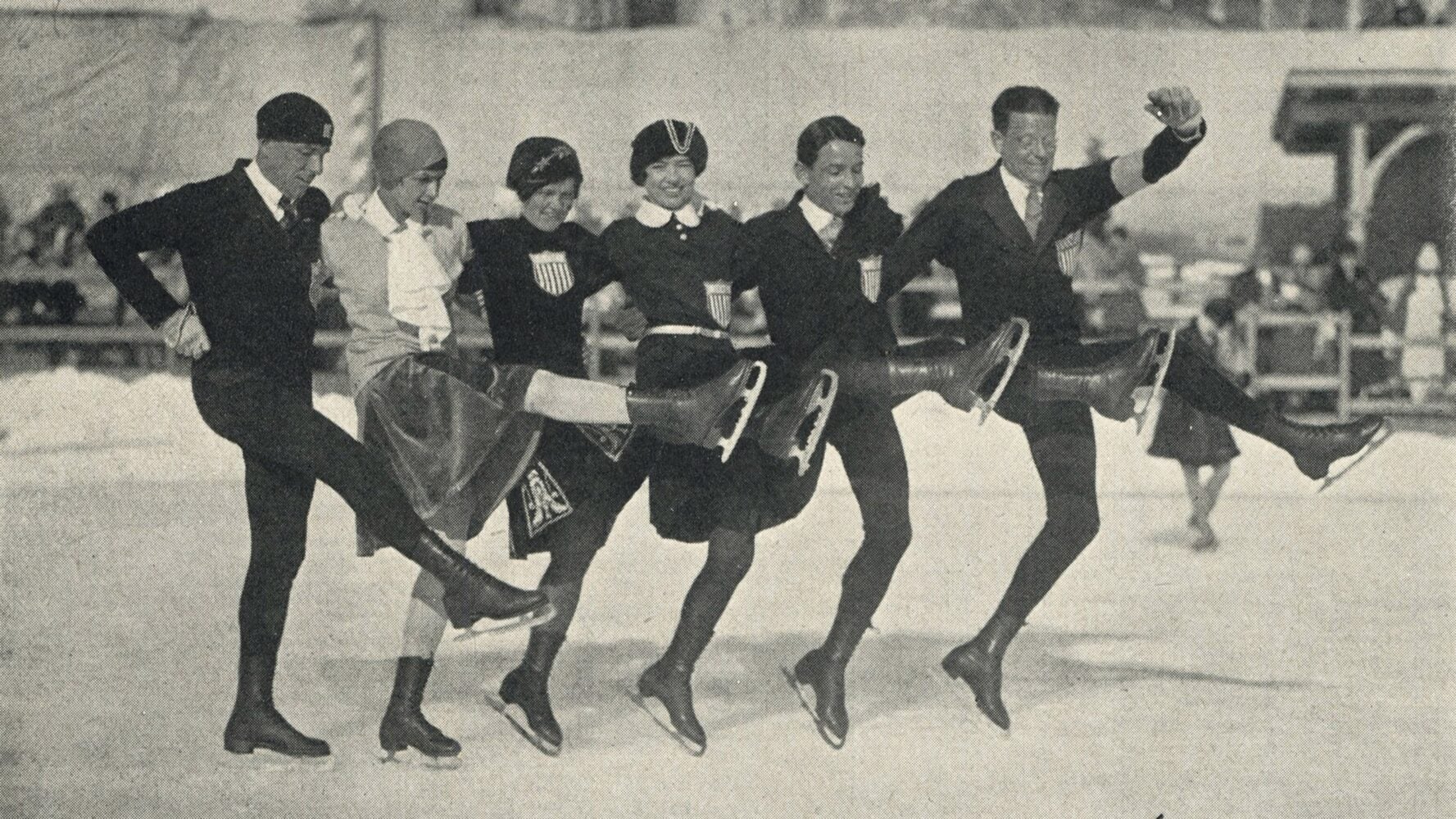
The United States figure skating team at the 1928 Winter Olympics. From left to right: Roger Turner, Maribel Vinson, Beatrix Loughran, Theresa Blanchard, Sherwin Badger, Nathaniel Niles (Photo: See page for author, Public domain, via Wikimedia Commons)
As the 2026 Winter Olympics come to a close, one sport continued to showcase artistry as well as athleticism: figure skating. But after more than a century of strict music regulations, figure skaters are branching out into a whole new musical soundscape.
Classical music has been the standard for figure skating ever since the sport first debuted during the 1908 London Games. In fact, music with lyrics was actively banned by the International Skating Union: it was thought that lyrics might distract skaters and audiences alike from athletes’ performances.
As the sport grew more popular, figure skating routines began to use classical pieces that were popular off the ice as well. Some of the most commonly used tracks historically have been compositions like Ravel’s Bolero, Tchaikovsky’s Swan Lake or The Nutcracker, and Gershwin’s Rhapsody in Blue. Bizet’s Carmen was at the center of some drama a few decades ago when, during the 1988 Olympics, East German Katherina Witt and American Debi Thomas each used the same excerpt in their long programs. The ensuing rivalry was dubbed the “Battle of the Carmens” as both skaters competed for Olympic gold (Witt ultimately won.)
Other classical music juggernauts are indelibly linked to the Games. In 1984, British ice dancers Jayne Torvill and Christopher Dean became the first non-Russians to take Olympic gold, dancing to a four-minute, 28-second cut of Ravel’s Boléro. Olympic champion Michelle Kwan made her debut at just 17 years old skating to a harp concerto called Lyra Angelica, while Yuna Kim brought the first figure skating Olympic gold home to South Korea for skating to Gerswin’s Piano Concerto in F.
All of this started to change in 1988, when Ice Dance became the first figure skating category to allow lyrics, but it wasn’t until the PyeongChang Olympics in 2018 that athletes across every figure skating discipline were allowed to use music with lyrics in their performances.
One of the reasons for the change was an attempt to boost viewership. The International Skating Union thought allowing popular music (including hip-hop and rock) would attract younger viewers. Skaters were quick to adjust to this new freedom, with American figure skater Nathan Chen skating into first place to Elton John’s “Rocket Man” in 2022.
And yet despite it all, classical music continues to be a popular choice for figure skating: the soaring melodies, tension, and release integral to so many pieces make them ideal choices for skating choreography.
There is no definitive list of the most choreographed pieces in Olympic history, but looking through the Olympics figure skaters’ programs listed on the ISU website shows instrumental music dominating the 2026 competition. 68 percent of skaters chose repertoire without lyrics (excluding rhythmic ice dance, which due to its nature skewed entirely to rock, pop, or dance music). Top in the instrumental genre were soundtracks from film, TV, or video games, making up a whopping 22 percent of all program music. Japan's Riku Miura and Ryuichi Kihara even managed to take home the gold after their near-perfect free dance to the soundtrack of Gladiator.
And classical music continued to be well represented on the ice. Japan’s Shun Sato took home the bronze skating to Stravinsky's Firebird, while his countryman Yuma Kagiyama incorporated parts of Turandot in his program. Many skaters preferred contemporary classical composers to known icons, perhaps highlighting a desire to stand out and avoid comparisons to iconic choreography of the past. As a whole, male skaters were more likely to choose classical music from the traditional canon than female skaters, while women were much more likely to include music from musicals in their programs.
There were a few minor copycat cases this year, though certainly nothing as dramatic as the “Battle of the Carmens” of the 1980s. Polish pair Sofiia Dovhal and Wiktor Kulesza and American skaters Madison Chock and Evan Bates both pulled from the Westworld soundtrack – specifically, the flamenco-inspired, orchestral cover of The Rolling Stones’ “Paint it Black.” A contemporary classical piece titled “Rain In Your Black Eyes” was also used in two programs: one by Germany’s Julia Sauter during her free skate as well as the short program of male skater Cha Junhwan of South Korea.
From opera houses to Hollywood scores to pop anthems, the music of figure skating now spans a wider range than ever before. Yet even as new genres find their place on Olympic ice, the familiar strains of Tchaikovsky, Ravel, and Stravinsky continue to play alongside the athletes. For all the experimentation, classical music remains the sport’s surest companion.